

Taking the first step toward recovery is a courageous decision. If you've been searching for "substance abuse therapy near me" here in Massachusetts, this guide is designed to cut through the confusion and provide clear, actionable steps to help you find the right support on your journey.
Key Takeaways
- Understand Your Local Options: Massachusetts offers various levels of outpatient care, from intensive day programs (PHP) to more flexible schedules (IOP). Understanding these differences is the first step to finding the right fit for your life.
- Prioritize Comprehensive Care: Effective treatment addresses more than just substance use. Look for providers that offer "dual diagnosis" care to treat co-occurring mental health conditions like anxiety or depression simultaneously.
- Leverage Local and National Resources: You don't have to search alone. Utilize resources like the Massachusetts Substance Use Helpline and the national SAMHSA locator to find state-licensed, reputable treatment centers in your area.
- Let the Admissions Team Help with Insurance: Don't let insurance be a barrier. A quality treatment center's admissions team can verify your benefits for you, explaining your coverage in simple terms and removing a major source of stress.
Your Guide to Local Substance Abuse Therapy
Finding the right support system is the bedrock of a solid recovery. It’s about more than just a quick online search; it's about really understanding your options, knowing what good care actually looks like, and feeling empowered to ask the right questions. This guide is built to make that whole process a lot less intimidating.
We’re going to zero in on what truly matters when you're looking for outpatient care on the South Shore and beyond. From figuring out program intensity to making sure your mental health is treated right alongside substance use, every piece of the puzzle is important for your success.
Taking the time to understand these core components ensures that when you choose a provider, you are stepping into a partnership that is genuinely equipped to support your journey from day one. This initial effort pays dividends in long-term well-being.
Where to Find Addiction Treatment in Massachusetts
Figuring out where to even begin looking for help can feel like half the battle. When you’re ready to find substance abuse therapy near me, the goal is to move past a generic online search and tap into resources that point you toward real, effective care right here in Massachusetts.
The good news is, you don’t have to do it alone. Both national and state organizations offer excellent, confidential starting points. Think of them as tools to cut through the noise and zero in on accredited providers in your community, whether you're in Quincy, Marshfield, or Weymouth.
National and State Helplines
Sometimes, a simple phone call or a few clicks can open up a world of support. These resources are designed to be a first point of contact, staffed by people who genuinely understand what you're going through.
- SAMHSA National Helpline: The Substance Abuse and Mental Health Services Administration (SAMHSA) runs a free, confidential referral service that’s available 24/7. Their online Treatment Locator is incredibly helpful—you can filter by location, the level of care you need (like outpatient or an IOP), and other specific services.
- Massachusetts Substance Use Helpline: This is our state-specific resource, which means they have localized knowledge. They can point you toward services licensed by the Bureau of Substance Addiction Services (BSAS), so you know you’re finding a program that meets Massachusetts' high standards.
Expanding Your Search Terms
"Substance abuse therapy near me" is a solid start, but getting more specific can lead to much better results. Think about what you really need.
If you need a structured program that still fits around your life, try searching for "IOP South Shore MA." If you know that mental health is part of the picture, "dual diagnosis treatment near me" will connect you with providers who are equipped to handle co-occurring conditions. For a deeper dive into different program structures, you can learn more about day treatment programs to see if that intensity is the right fit.
Why a Doctor's Referral Is So Powerful
One of the most effective first steps is one people often overlook: talking to your primary care physician. Your doctor knows your medical history and can provide a trusted, confidential referral to a specialist or treatment center they personally know and respect.
This approach immediately personalizes your search. Instead of sorting through dozens of options, a doctor’s recommendation can cut through the uncertainty and connect you directly with a high-quality provider. This is especially critical when you consider the current treatment gap.
The need for accessible local care is staggering. In the United States, only 23.6% of the 30.5 million people who needed substance use treatment in the past year actually received it. Among young adults aged 18-25, this number drops to just 16.6%, highlighting a severe public health crisis. You can discover more insights about these addiction statistics on TherapyRoute.
By using these targeted resources—from national locators to a simple conversation with your doctor—you can turn a daunting search into a clear, manageable plan. It’s the best way to ensure you find a program that not only feels right but is clinically equipped to support your unique journey to recovery.
How to Choose the Right Therapy Provider
You’ve done the initial research and have a list of potential centers. Take a moment to recognize that this is a huge step. Now comes the part where you dig in and figure out which provider is the best fit for your specific needs. It’s not about finding the fanciest facility; it’s about finding the right clinical care, a supportive environment, and a team that genuinely gets it.
To make a smart choice, you need to know what to look for and what questions to ask. Think of yourself as an interviewer. You're vetting these programs to find a true partner in your recovery. The goal is to compare local Massachusetts centers based on what really counts—the quality of their care and how it lines up with your life.
This simple flowchart breaks down the two main paths you can take to get started.
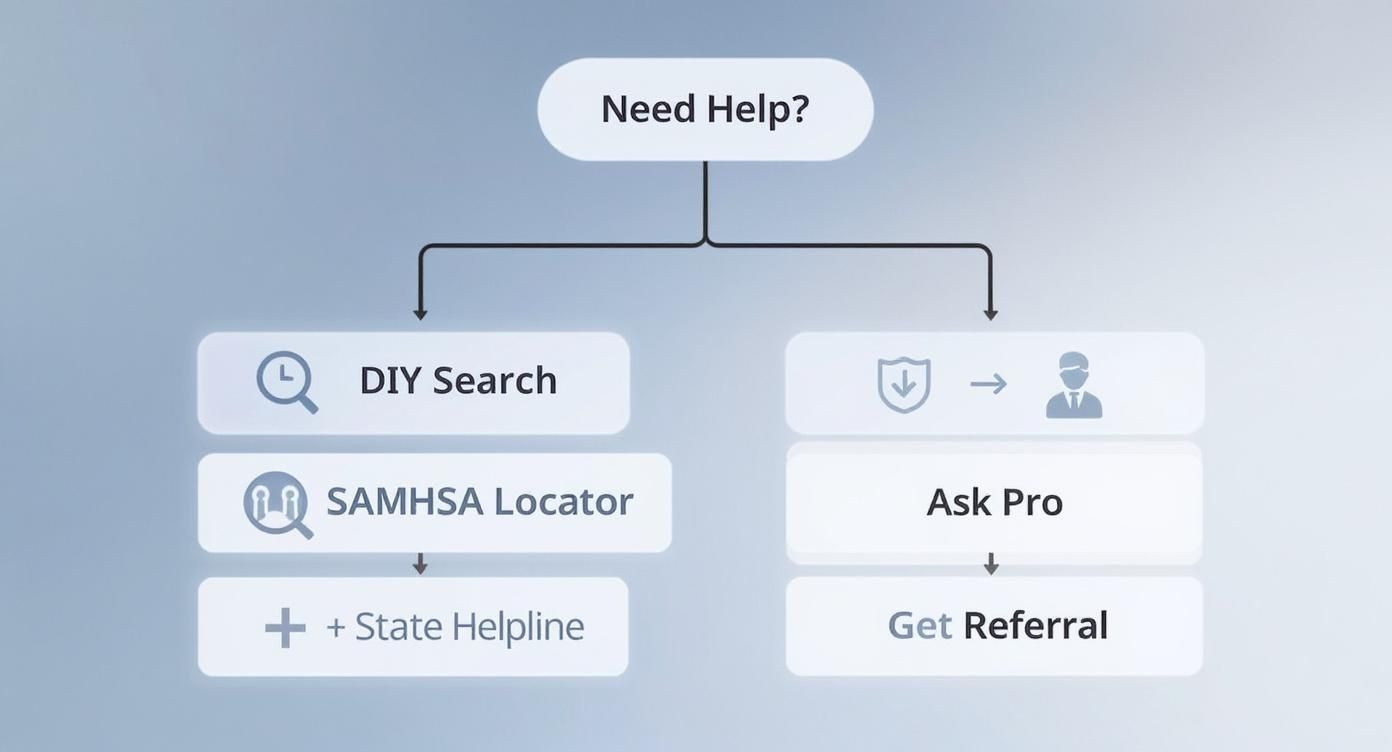
As you can see, there’s no single "right" way. Whether you prefer to do your own legwork or get a professional referral, both roads can lead you to the right place.
Evaluate Their Treatment Methods
Not all therapy is the same. The best providers use evidence-based therapies, which are just treatment models that have been proven to work through solid scientific research. When you call a center, don't be shy about asking what specific therapeutic approaches they use.
You’ll probably hear acronyms like CBT and DBT thrown around. Cognitive Behavioral Therapy (CBT) is a workhorse in this field. It’s all about helping you identify and change the destructive thinking patterns and behaviors that fuel substance use. It’s incredibly effective for both addiction and common co-occurring conditions like anxiety. To see how it works in practice, you can explore this overview of what Cognitive Behavioral Therapy is.
Another powerful tool is Dialectical Behavior Therapy (DBT), which is fantastic for learning to manage intense emotions and build healthier relationships. The bottom line is to find a program that has these proven methods at the core of their treatment plan.
To help you get familiar with the terminology, here’s a quick breakdown of some common therapies you'll encounter.
Key Treatment Modalities at a Glance
| Therapy Type | Best For | Core Principle |
|---|---|---|
| Cognitive Behavioral Therapy (CBT) | Widespread use for SUD, anxiety, and depression. | Identifying and changing negative thought patterns and behaviors. |
| Dialectical Behavior Therapy (DBT) | Emotional dysregulation, trauma, and borderline personality disorder. | Developing skills in mindfulness, distress tolerance, and emotional regulation. |
| Motivational Interviewing (MI) | Ambivalence about change; building motivation. | A collaborative conversation to strengthen a person's own motivation for change. |
| Eye Movement Desensitization and Reprocessing (EMDR) | Trauma and PTSD. | Processing traumatic memories to reduce their emotional impact. |
This isn't an exhaustive list, but it gives you a good idea of the kinds of specialized, effective treatments a high-quality center should offer.
Prioritize Dual Diagnosis Care
Substance use and mental health issues are often two sides of the same coin. According to the National Institute on Drug Abuse, about half of people with a substance use disorder will also have a co-occurring mental health disorder at some point. This is precisely why dual diagnosis care isn't just a nice-to-have feature—it's absolutely essential for real, lasting recovery.
A program that truly understands this will treat both conditions at the same time. This integrated approach gets to the root causes of substance use instead of just papering over the symptoms, which leads to much better, more sustainable outcomes.
When you call a potential provider, ask this question directly: "How do you treat co-occurring conditions like depression or PTSD?" Their answer will reveal a lot about their clinical expertise and depth.
Ask About Medication-Assisted Treatment (MAT)
For anyone recovering from opioid or alcohol use disorders, Medication-Assisted Treatment (MAT) can be a game-changer. MAT combines FDA-approved medications with counseling to reduce cravings and manage withdrawal symptoms. This provides critical stability, allowing you to fully engage in the therapeutic work of recovery.
It’s a crucial question to ask upfront, as not every outpatient center offers MAT. If it’s something you might need, ask which medications they use (like Suboxone or Vivitrol) and how that medical care is woven into your overall therapy plan. A center that offers integrated MAT is showing a commitment to using every available tool to help you succeed.
Inquire About Family Involvement
Addiction doesn’t happen in a vacuum; it impacts the entire family. A treatment center that gets this will offer dedicated support programs for your loved ones. These programs are designed to educate family members about the disease of addiction, teach healthier ways to communicate, and start the process of repairing strained relationships.
When the family heals together, it builds a powerful and informed support network for you back at home, which can make all the difference. Ask what they offer. Do they have family therapy sessions? Educational workshops? Support groups? A strong commitment to family healing is one of the clearest signs of a high-quality, person-centered program.
Sorting Out Insurance and Your Benefits
Let's be honest: worrying about how to pay for treatment is a huge source of stress, and it shouldn't stop you from getting help. Figuring out health insurance can feel like trying to solve a puzzle in a foreign language, but here's the good news: you don't have to do it alone.
Most health plans, whether you're here in Massachusetts or elsewhere, are now required to cover mental health and substance use treatment. The main hurdle is just figuring out the specifics of your plan—and a good treatment center can actually take that off your plate entirely.
Getting a Handle on Your Coverage
The most straightforward way to get answers is to just pick up the phone and call the member services number on the back of your insurance card. You can cut through the confusion by asking a few very specific questions.
For instance, if you have a Blue Cross Blue Shield plan here in Massachusetts, you could call and ask:
- "What are my in-network benefits for outpatient behavioral health?"
- "Do I need prior authorization for an Intensive Outpatient Program (IOP)?"
- "Can you tell me my copay, coinsurance, and deductible for this type of care?"
Jotting down the answers to these questions will give you a pretty clear picture of what to expect financially. But honestly, there’s an even easier way.
So many people get bogged down in insurance jargon and just give up. The admissions team at a treatment center navigates this world every single day. Letting them do the heavy lifting for you is the quickest and least stressful way to get clear, accurate information.
Let the Admissions Team Be Your Guide
Think of a good treatment center's admissions team as your personal advocate. Their entire job is to clear the path to treatment, and that absolutely includes wrangling with insurance companies.
When you reach out to a provider like South Shore Recovery Center, you can simply give them your insurance information. They'll take it from there.
They contact your insurance company directly, figure out exactly what’s covered, and then walk you through any potential out-of-pocket costs in simple, easy-to-understand terms. This service is always free and confidential. It takes the burden completely off your shoulders so you can focus on what really matters—getting better. Often, you can kickstart the process with a simple online form, like this one to verify your insurance coverage, in just a couple of minutes.
This step is more important than ever. In 2023, an estimated 54.2 million people aged 12 and older needed substance abuse treatment, but a staggering number of them never got it. Knowing how to use your insurance is a critical piece of closing that gap. For a broader look at these trends, the annual World Drug Report offers some powerful insights.
What to Expect in Your First Few Sessions
Walking into therapy for the first time can feel a little intimidating. It's totally normal to be nervous. But it helps to know that those first few days aren't about being put on the spot—they're about building a foundation of trust so you can feel safe, heard, and ready to start the real work of recovery.
The process kicks off with what’s called an intake assessment. This is just a confidential, one-on-one conversation with a clinician. It’s not an interrogation. The whole point is for them to get to know your story: your history with substance use, any mental health challenges you're facing, and what you’re hoping to get out of treatment.
Think of it less like paperwork and more like the first step in creating a treatment plan that’s actually designed for you.
Your First Week in an IOP
Once the intake is done, your first week in a Massachusetts Intensive Outpatient Program (IOP) gets into a rhythm. Most of your time will be a blend of group sessions and individual counseling, and both serve a very different, but equally important, purpose.
- Group Therapy: This is really the heart of most IOPs. You’ll be in a small group with a therapist and other people who are going through similar struggles. It’s a place to talk about challenges, celebrate small wins, and learn new coping skills from each other. There's a lot of power in finally realizing you're not the only one.
- Individual Counseling: You’ll also get dedicated one-on-one time with your therapist. These sessions are your private space to dig into the things that are harder to talk about in a group, process tough emotions, and track the specific goals in your treatment plan.
Your first few sessions are all about building a connection—with your therapist and with the other people in your group. Try to be as open as you're comfortable with. Honesty is the key to making therapy work.
Getting the Most Out of Early Sessions
That first week can feel like a lot to take in, but a few simple shifts in perspective can make a huge difference. First off, just showing up is a massive win, so give yourself credit for that.
When you're in group sessions, it can be helpful to listen more than you talk at first. You might be surprised by how much you can learn just by hearing other people’s stories and insights.
In your individual sessions, don't be afraid to ask questions. Be clear about what you need and what you're feeling. If a particular approach isn’t clicking for you, speak up. This is your recovery journey. Finding the right substance abuse therapy near me is the first step, but actively participating is what creates real, lasting change.
Building Your Long-Term Recovery Plan
Finishing a treatment program is a huge accomplishment, but it's really the starting line for the rest of your recovery. Think of the skills you learned in therapy as your toolkit for building a new, sober life. This next phase is all about putting those tools to work with a solid aftercare and relapse prevention plan.
https://www.youtube.com/embed/MYgEY_pa9y0
A strong aftercare plan is your roadmap for handling whatever life throws at you without falling back on old habits. The best centers in Massachusetts start working on this plan with you from the very beginning, making sure you have a clear path forward when you walk out the door.
What a Strong Aftercare Plan Includes
Your aftercare plan isn't set in stone; it's a living document that should grow and change with you. It's your proactive strategy for staying connected to support and keeping your eyes on your goals.
A good plan usually has a few key pieces:
- Continuing Therapy: Stepping down to a less intensive outpatient group or one-on-one counseling gives you that consistent support while you get back into the rhythm of daily life.
- Support Groups: Getting involved with groups like Alcoholics Anonymous (AA) or Narcotics Anonymous (NA) in your local Massachusetts community is essential. It connects you with people who just get it.
- Healthy Routines: It might sound simple, but creating a solid structure with regular sleep, good nutrition, exercise, and hobbies builds stability. That stability is the foundation of long-term recovery.
Think of your aftercare plan as the scaffolding that supports you while your new, sober life solidifies. It's not a sign of weakness; it's a smart, strategic approach to protecting the progress you've worked so hard to achieve.
Preparing for Moments of Crisis
Recovery has its ups and downs. It’s absolutely critical to have a game plan for when you feel overwhelmed or are tempted to relapse. This isn't about expecting to fail; it's about being prepared to win.
Your crisis plan should be simple: a list of trusted people you can call immediately—your sponsor, therapist, or a supportive family member. Keep their numbers handy. It should also have contact info for local emergency resources. Reaching out for help in those tough moments is a sign of incredible strength.
The gap in continuing care is a serious problem. In 2023, only 14.6% of people who needed help for a substance use disorder actually received any treatment. We know that intervention works—the recent drop in fatal overdoses from over 113,000 to 94,000 is proof of that—but long-term success depends on ongoing support. You can discover more insights about this global crisis and opportunity on Dianova.org.
This data makes it crystal clear: a robust aftercare plan isn’t just helpful—it’s life-saving.
Frequently Asked Questions
How do I know what level of care I need?
You don't have to figure this out alone. The first step at any treatment center is a professional clinical assessment. A clinician will talk with you to understand your specific situation and recommend the most appropriate level of care, whether that's a more intensive day program (PHP) or a more flexible intensive outpatient (IOP) schedule.
What is dual diagnosis care?
Dual diagnosis is a comprehensive treatment approach that addresses both a substance use disorder and any co-occurring mental health conditions—like anxiety, depression, or PTSD—at the same time. Because these issues are often interconnected, treating them together is critical for effective, long-lasting recovery.
Will my treatment be confidential?
Absolutely. Your privacy is protected by strict federal laws like HIPAA and 42 CFR Part 2, which has even stronger protections for substance use records. A treatment center cannot share any information about your care without your explicit written consent, except in very rare cases involving immediate harm to yourself or others.
How long does outpatient therapy in Massachusetts last?
There is no one-size-fits-all answer, as treatment length is tailored to your individual progress and needs. Generally, many people participate in an Intensive Outpatient Program (IOP) for about 30 to 90 days before transitioning to a less frequent aftercare or alumni group for ongoing support. The goal is to ensure you feel confident and prepared for long-term recovery.
