
Taking the first step toward recovery can feel overwhelming, but you don’t have to do it alone. Outpatient addiction treatment programs in Massachusetts offer a supportive, flexible path to healing that allows you to maintain your daily life—like work, school, and family—while building a strong foundation for sobriety.
4 Key Takeaways About Outpatient Treatment
| Key Takeaway | What This Means for You |
|---|---|
| Flexible Care Levels | Treatment isn't one-size-fits-all. The time commitment can be adjusted to match your specific recovery needs and life schedule right here in Massachusetts. |
| Evidence-Based Therapies | You’ll work with proven clinical methods like CBT and MAT that get to the root causes of addiction for real, lasting change. |
| Integrated Dual Diagnosis | If you’re also dealing with a mental health condition, you can get coordinated treatment for both issues at the same time, in the same place. |
| Maintain Daily Life | The outpatient model is designed to fit into your world, letting you keep working, going to school, and living at home with structured support. |
Finding the Right Fit: Your Recovery Options in Massachusetts
Making the decision to get help is the single most important part of this journey. Here in Massachusetts, outpatient addiction treatment programs provide a structured, proven framework for recovery without asking you to move into a facility. The whole idea is built on a simple but powerful truth: recovery and real life can, and should, happen at the same time.
For so many people, this is just a more realistic and manageable way to do things. It gives you a chance to learn new coping skills in a clinical setting and then immediately put them to the test when you face real-world challenges at home, on the job, or in your community.
Why More People are Choosing Outpatient Care
The practical nature and proven success of this model have made it a go-to choice in modern addiction treatment. It’s not just a trend; outpatient addiction treatment programs now make up the largest part of substance abuse treatment services around the world. Why? It often comes down to being more affordable and more likely to be covered by insurance.
Market data consistently shows that outpatient services hold the largest market share, well ahead of inpatient and residential options. This shift is happening because these programs don't force you to completely step away from your life. You can learn more about these market trends and what they mean for treatment access.
Think of this guide as your roadmap. We’ll explore each of these concepts so you can feel confident in finding compassionate, effective care that’s truly designed for you.
Understanding the Levels of Outpatient Care
When you start looking into treatment, the different program names can feel a bit overwhelming. But it’s simpler than it sounds. Think of it like a staircase—you find the step that matches where you are right now, whether you're just starting out or looking to solidify your recovery long-term.
The great thing about outpatient addiction treatment programs is that they aren’t a one-size-fits-all solution. They represent a spectrum of support that can be dialed up or down as you progress. This flexibility is what allows you to start healing without having to completely disconnect from your job, family, and community right here in Massachusetts.
The Most Intensive Step: Partial Hospitalization Programs (PHP)
At the top of the outpatient staircase, you'll find the Partial Hospitalization Program (PHP), which you might also hear called a Day Treatment Program. This is the most structured and immersive level of outpatient care you can get. It’s an ideal choice for someone who needs a high degree of support but has a safe, stable home to return to each evening.
Think of a PHP as making recovery your full-time job for a little while. You’ll typically be at the center for 5-6 hours a day, five days a week. Your days are filled with individual therapy, group sessions, and medical appointments, all designed to give you a solid foundation to build your recovery on.
A Balanced Approach: Intensive Outpatient Programs (IOP)
One step down is the Intensive Outpatient Program (IOP). This level still provides a really strong support system but with more flexibility than a PHP, which is a game-changer for people who need to keep up with work, school, or family commitments. An IOP gives you the chance to put the skills you're learning into practice in the real world, every single day.
An IOP usually involves about 9-12 hours of treatment per week, typically broken down into three-hour blocks on three or four different days. Many centers in Massachusetts offer morning or evening sessions to fit around your schedule. You can see how an intensive outpatient program in Massachusetts strikes this important balance between treatment and daily life.
The visual below really captures the essence of what makes these programs work so well.
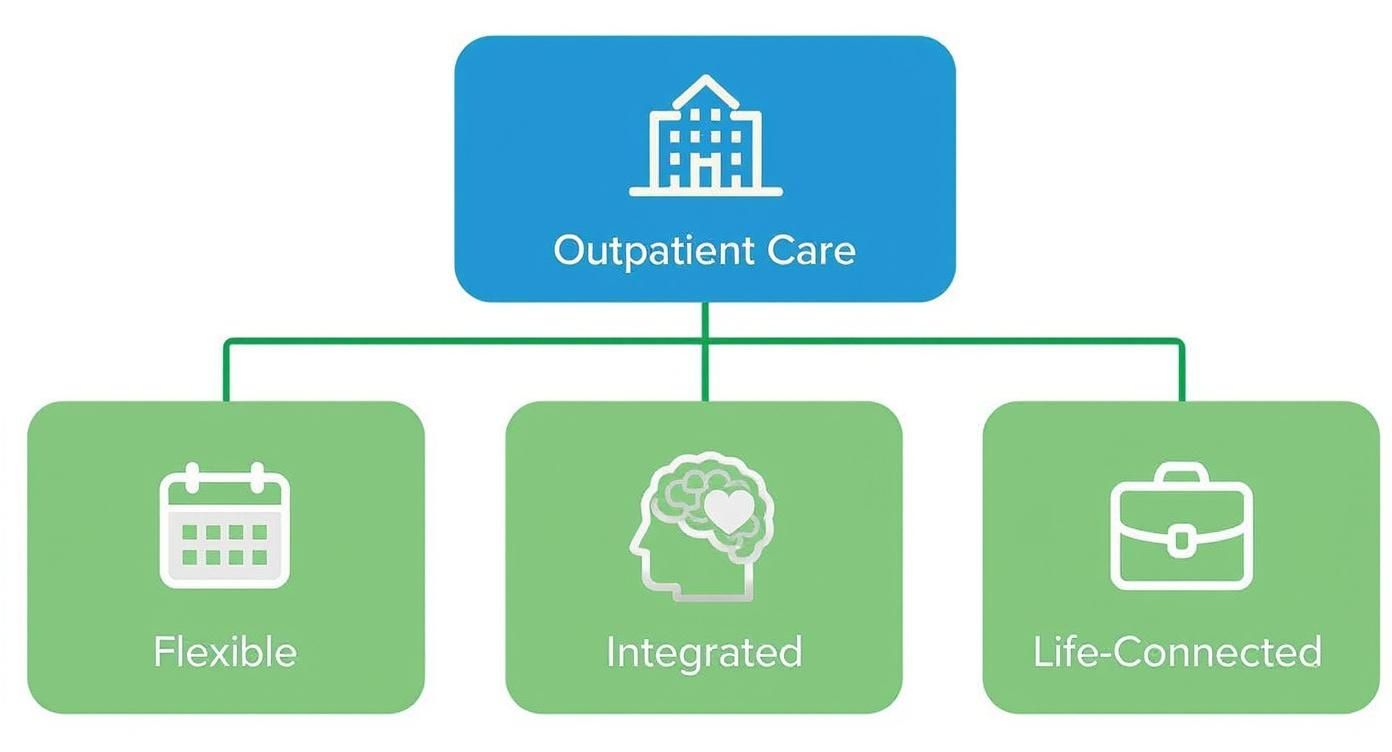
It shows how outpatient care is built to be flexible, to integrate with your mental health needs, and to stay connected to your actual life.
Maintaining Progress with Standard Outpatient Programs (OP)
The final step is the standard Outpatient Program (OP). This is the most flexible option, designed either as a step-down to provide ongoing support or for individuals who simply need a lighter touch from the get-go.
An OP is a crucial tool for maintaining long-term recovery. It might only involve a couple of hours of therapy each week, like one group and one individual session. That consistent check-in reinforces the coping skills you’ve developed and offers a vital source of accountability as you navigate sobriety.
The Core Therapies That Drive Real Change
Any effective outpatient addiction treatment program is more than just a place to talk. At its heart, it's a structured environment built on proven therapeutic methods—the kind backed by real science. These therapies are designed to help you understand what makes you tick and equip you with practical, real-world skills for a new way of life.
Think of these therapies as the tools in your toolbox. Each one has a specific job, and together, they help you build a strong, lasting foundation for recovery. We're not just trying to manage symptoms; we're getting to the root of the thoughts and feelings that drive substance use in the first place. The goal is to give you the power to handle life’s challenges without turning back to old habits.
Cognitive Behavioral Therapy: The Blueprint for New Habits
One of the most powerful and widely used tools you'll encounter is Cognitive Behavioral Therapy (CBT). The idea behind CBT is actually quite simple: our thoughts, feelings, and actions are all connected. If we can learn to spot and challenge the negative thought patterns that trip us up, we can fundamentally change how we act.
Let's say your automatic response to a stressful day is to reach for a drink. CBT helps you press pause on that impulse. You learn to examine the thought driving the urge, which might be something like, "I can't cope with this feeling." A therapist works with you to reframe that into something more accurate and empowering, like, "This is tough, but I have other ways to manage stress now."
With practice, this process literally builds new pathways in your brain, making healthier responses feel more natural over time. It’s a practical, hands-on approach that builds real resilience. You can learn more about how we use CBT for addiction treatment here in Massachusetts.
Medication-Assisted Treatment: Easing the Physical Path
For many people, especially those recovering from opioid or alcohol addiction, the physical side of recovery is a massive hurdle. Intense cravings and withdrawal symptoms can easily derail even the most motivated person. This is where Medication-Assisted Treatment (MAT) comes in.
MAT is a clinical approach that uses specific, FDA-approved medications to manage these tough physical challenges. It's a common misconception that this is just "replacing one drug with another"—that couldn't be further from the truth. These medications work by stabilizing brain chemistry to reduce cravings and prevent the worst of withdrawal, giving you the clarity and stability to fully engage in therapy.
MAT provides a biological foundation that allows the real psychological work to happen. It's about using every proven tool available to support someone's journey to lasting health.
The value of this integrated approach is clear. The global drug addiction treatment market is on track to exceed USD 31.2 billion by 2032, with therapies like CBT and MAT expected to account for over half of that market.
Building Emotional Strength with DBT and Other Therapies
Beyond CBT and MAT, a truly comprehensive outpatient program will draw from a variety of therapies to help you build a well-rounded skill set for sobriety. Managing emotions and navigating relationships are crucial pieces of the puzzle for a fulfilling, substance-free life.
- Dialectical Behavior Therapy (DBT): Originally created for other conditions, DBT has proven incredibly effective for addiction. It focuses on teaching four key skills: mindfulness, distress tolerance, emotion regulation, and building healthier relationships.
- Motivational Interviewing (MI): This isn't about a therapist telling you what to do. MI is a collaborative conversation designed to help you find and strengthen your own motivation to change, working through any mixed feelings along the way.
- Mindfulness-Based Therapies: Practices like meditation and yoga teach you to observe your thoughts and feelings without judgment. This creates a small but powerful gap between feeling an urge and acting on it, giving you the space to choose a different response.
By weaving these powerful therapies together, outpatient addiction treatment programs in Massachusetts offer a robust toolkit for recovery. It’s not just about getting sober—it’s about building a healthier, more meaningful life you're excited to live.
Healing Holistically with Dual Diagnosis Care
For so many people walking through our doors, addiction is only half the story. It’s incredibly common for substance use to go hand-in-hand with challenges like anxiety, depression, bipolar disorder, or past trauma. When both are happening at the same time, we call it a dual diagnosis, or a co-occurring disorder.
Trying to treat just the addiction without addressing the underlying mental health issue is like trying to fix a leaky pipe while ignoring the extreme water pressure that caused it to burst. You might patch the leak for a little while, but the real problem is bound to cause another one somewhere else. For a recovery that actually lasts, you need an integrated approach that heals both at the same time.
Why Integrated Care Is So Important
It wasn't that long ago that treatment for addiction and mental health happened in totally separate worlds. You’d see one specialist for your depression and another for your alcohol use, and those two professionals would rarely, if ever, talk. We know now that this siloed approach just doesn't work, because the two issues are almost always tangled together, each one making the other worse.
Think about it: someone might use alcohol to quiet the noise of their social anxiety, but over time, the drinking just fuels even more anxiety. Or maybe a person’s untreated depression completely drains them of the energy and motivation needed to stay sober. Today, high-quality outpatient addiction treatment programs in Massachusetts get this connection and treat both issues right under one roof.
With an integrated model, your therapists, case managers, and medical staff are all on the same page. They work together to build one solid treatment plan that addresses the full picture of your health. You can explore a detailed overview of what a coordinated dual diagnosis treatment program looks like and how it truly supports a lasting recovery.
What to Expect in Dual Diagnosis Treatment
A strong dual diagnosis program doesn't just offer addiction therapy plus mental health therapy. It provides care that is built on a deep understanding of how the two interact.
- Coordinated Psychiatric Care: A psychiatrist is often on staff to help manage medications for both mental health and substance cravings, making sure everything works together safely and effectively.
- Specialized Group Therapy: Group discussions are designed specifically to tackle the overlap. You might talk about how substance use messes with your mood, learn healthy ways to cope with anxiety triggers, or process trauma in a safe, supportive space.
- Individualized Therapy: In your one-on-one sessions, you'll dig into the specific ways your mental health and substance use are connected, helping you untangle those complex patterns in your thoughts and actions.
A landmark study from the National Institute on Drug Abuse revealed a staggering statistic: about 37.9% of adults with a substance use disorder also had a mental illness. This isn't a small niche—it shows why integrated treatment is an absolute necessity for a huge portion of people seeking help.
Choosing a provider in Massachusetts with real experience in dual diagnosis is one of the most critical decisions you'll make for your recovery. It means you’re building your new life on a foundation that’s stable, strong, and ready to support all of you. This is how you finally break the cycle and start moving toward the healthier, more balanced life you deserve.
How to Choose the Right Massachusetts Program
With so many programs out there, trying to find the right outpatient addiction treatment in Massachusetts can feel overwhelming. But taking this step is one of the most powerful things you can do for yourself. When you find a program that truly fits you, you’re giving yourself the best shot at building a recovery that lasts.
Think of it this way: you wouldn't hire a contractor for a major home project without checking their credentials and seeing if their approach feels right. The same logic applies here. Taking a little time to ask smart questions and weigh your options will make all the difference.
Start With the Essentials: Licensing and Accreditation
Before getting into the details of therapy and schedules, your very first check should be for legitimacy. Any reputable treatment center in Massachusetts must be licensed by the state. This isn't just a suggestion; it’s a hard requirement that proves they meet fundamental safety and care standards.
If a center has that, look for another layer of quality: accreditation from national bodies like The Joint Commission or CARF. Earning one of these is a big deal. It means the facility volunteered for an intense review of its practices and proved its commitment to excellent care. It’s a quick way to know you’re looking at a top-tier provider.
Does Their Treatment Approach Match Your Needs?
Not every program is a one-size-fits-all solution. A center can have a great reputation, but if its services don’t line up with what you’re going through, it’s not the right place for you.
For example, if you’re dealing with anxiety or depression alongside substance use, you absolutely need a program with a strong dual-diagnosis track. Likewise, you should ask about the kinds of therapy they actually use. Do they rely on proven methods like Cognitive Behavioral Therapy (CBT), offer Medication-Assisted Treatment (MAT), or specialize in skills-based approaches like Dialectical Behavior Therapy (DBT)? Knowing their clinical philosophy helps you find a program that gets to the real roots of addiction.
Practical Steps for Making Your Decision
The need for accessible treatment is staggering. In recent years, an estimated 41.5 million adults required substance abuse treatment, yet only about 24.2% of them received it. Outpatient programs are critical for closing that gap—in fact, 82% of all treatment facilities offer this kind of flexible care. You can find more data on treatment utilization at DrugAbuseStatistics.org. Finding a program that works with your life is the key to getting help.
Finding the right outpatient program is about more than just clinical methods; it's about finding a place where you feel seen, understood, and supported. The initial consultation is your opportunity to gauge the center's culture and ensure it feels right for you.
To help you feel confident in your choice, we've put together a checklist of essential questions to ask any Massachusetts provider you're considering.
Questions to Ask a Massachusetts Treatment Provider
This table is a simple tool to help you gather the information you need to compare programs and find the best one for your unique situation.
| Category | Key Questions to Ask |
|---|---|
| Licensing & Accreditation | Are you licensed by the state of Massachusetts? What accreditations do you hold (e.g., CARF, The Joint Commission)? |
| Therapies & Staff | What specific evidence-based therapies do you use? What are the credentials of your clinical staff? |
| Dual Diagnosis Care | How do you integrate mental health treatment with addiction therapy? Do you have a psychiatrist on staff? |
| Logistics & Cost | What insurance plans do you accept? Can you provide an estimate of my out-of-pocket costs? What is the weekly time commitment? |
| Aftercare Planning | What does your aftercare or alumni program look like? How do you help clients transition after the program ends? |
By asking these questions, you shift from hoping you’ve found a good fit to knowing you have. This empowers you to choose a Massachusetts outpatient addiction treatment program that not only meets the highest clinical standards but also feels like the right partner for your recovery.
Building a Life in Long-Term Recovery
Finishing an outpatient program is a huge accomplishment, and you should be incredibly proud. It’s the end of one crucial chapter, but it's also the beginning of the next one: building a life you love, grounded in recovery. This new phase is all about taking the tools and insights you've gained and weaving them into the fabric of your everyday routine.
Lasting sobriety isn't just about gritting your teeth and relying on willpower. It’s about creating a strong support system and having a plan for when life gets messy. This is exactly what aftercare is for. Think of it as a bridge that safely connects the structured support of a treatment program to the freedoms and realities of your daily life. A solid aftercare plan becomes your personal roadmap for the journey ahead.

Creating Your Relapse Prevention Plan
One of the most valuable tools you’ll develop in treatment is your relapse prevention plan. It’s like a personalized safety net that you and your therapist build together. This isn't about planning to fail—quite the opposite. It’s about preparing for life’s challenges so you have a clear path to success.
The plan starts by helping you get honest about your personal triggers. What people, places, or feelings create that urge to use? Once you know what they are, the plan outlines a concrete set of healthy coping strategies you can use in the moment. Instead of turning to a substance, your plan might be to call your sponsor, practice a mindfulness exercise, or go for a walk along the beach.
A well-crafted relapse prevention plan empowers you to respond to high-risk situations with confidence instead of fear. It shifts the dynamic from reacting to an urge to proactively managing your recovery.
This isn't a document you just file away and forget. It’s a living guide that you’ll update and strengthen as you continue to grow.
The Power of Ongoing Support
Recovery flourishes when we're connected to others. After completing an outpatient addiction treatment program, staying plugged into a supportive community is one of the best things you can do to maintain your progress. Thankfully, there are plenty of great options for this right here in Massachusetts.
- Alumni Programs: We, like many treatment centers, have an active alumni group. It’s an amazing way to stay in touch with people who truly get it and with staff who can offer continued guidance.
- Community Support Groups: Organizations like Alcoholics Anonymous (AA) and Narcotics Anonymous (NA) have meetings all over the state. They are a powerful source of shared experience, accountability, and fellowship.
- Continued Therapy: Many people find it helpful to "step down" to a weekly individual or group therapy session. This provides consistent, professional support as you put your new skills into practice.
By intentionally building this network, you make sure you always have someone to call, whether you're celebrating a win or just having a tough day. This web of support is the scaffolding that helps you build a strong, resilient, and deeply fulfilling life in long-term recovery.
Frequently Asked Questions About Outpatient Treatment
Deciding to get help is a huge step, and it's completely normal to have a lot of practical questions. You're not alone in wondering about the details. We've put together some straightforward answers to the questions we hear most often about outpatient addiction treatment programs here in Massachusetts. Our goal is to clear up any confusion and help you feel more comfortable and confident about what comes next.
1. How do I know if outpatient treatment is the right fit for me?
Outpatient care is generally a fantastic option if you have a safe and supportive home life and don't need a medically supervised detox to get started. If you need to keep up with your job, school, or family commitments in Massachusetts, it’s designed for exactly that. The best way to know for sure is to talk with a professional for an initial assessment.
2. Can I really keep my job while I'm in an IOP in Massachusetts?
Absolutely. That’s one of the main reasons Intensive Outpatient Programs (IOPs) exist. Most programs in Massachusetts, including ours, are built with real schedules in mind. Sessions are often held in the mornings or evenings, giving you the flexibility to get treatment without disrupting your entire life.
3. How long does an outpatient program actually take?
There's no one-size-fits-all answer, because treatment is tailored to you. Generally, you can expect an Intensive Outpatient Program (IOP) to last somewhere between 8 and 12 weeks. After that, it's common to "step down" to a standard Outpatient Program (OP) for a while to maintain that support system.
4. What role does my family play in all of this?
Family can be one of your greatest assets in recovery, so their involvement is not just welcome—it's encouraged. Many programs offer family therapy and educational workshops to help your loved ones understand what you're going through. It’s a chance for everyone to heal, rebuild trust, and learn how to create a home environment that truly supports your new, sober life.
