
Navigating insurance to find substance abuse treatment in Massachusetts can feel overwhelming, but you don't have to do it alone. This guide is your clear, simple roadmap to understanding your rights, what your plan likely covers, and how to get the care you or a loved one deserves without the stress of figuring it all out by yourself.
Key Takeaways
- Coverage is Legally Required: Federal and Massachusetts state laws, like the Mental Health Parity and Addiction Equity Act (MHPAEA), mandate that most insurance plans cover addiction treatment as an essential health benefit, just like any other medical condition.
- You Have Specific Rights: Parity laws prevent insurers from imposing stricter limits on substance abuse treatment compared to medical care. This applies to deductibles, copays, and visit limits, ensuring fair access.
- Verification is the First Step: Before enrolling in any program, it is crucial to verify your insurance benefits. This confirms whether a provider is in-network and clarifies your out-of-pocket costs, such as deductibles and copayments, preventing unexpected bills.
- Expert Help is Available: You are not expected to be an insurance expert. Treatment center admissions teams specialize in this process and can handle the verification for you, providing fast, accurate answers and removing a significant burden.
Your Path to Recovery Starts with Understanding Your Insurance
Figuring out insurance coverage is often the first big hurdle people face when they decide to get help. The jargon, the paperwork, the phone calls—it can all feel like too much. But here's the most important thing to remember right from the start: you have rights and protections that are specifically designed to make sure you can get treatment.

Recent healthcare laws have made a huge difference in opening up access to addiction treatment. Over the last ten years, we've seen expanded insurance eligibility and better enforcement of parity laws, which has helped lower the financial walls for millions of people.
While it's true that only about 14.6% of people with a substance use disorder received treatment in 2023, that number is actually a big step up from where it used to be. It shows that these changes are slowly but surely working. You can discover more insights about these market trends to see the bigger picture.
The most critical thing to hold onto is this: Addiction is a medical condition, and your insurance plan is required by law to treat it that way. This legal protection is your strongest tool for getting help.
Navigating Your Insurance Plan for Treatment in Massachusetts
When you're ready to seek help for substance use, figuring out your insurance can feel like the first major hurdle. In Massachusetts, you'll likely have one of three main types of coverage: private insurance, MassHealth, or Medicare. Think of it this way—they're all different roads, but they can all lead to the same destination: recovery.
Let's walk through what each one looks like so you can get a clear sense of the path ahead.

Private Insurance Plans
Many folks in Massachusetts get their health insurance through an employer or by buying a plan directly. You'll probably recognize the big names here: Blue Cross Blue Shield of Massachusetts, Tufts Health Plan, and Harvard Pilgrim Health Care are some of the most common.
These plans operate with a network of doctors and facilities they've approved. Sticking in-network is your best bet for keeping costs down; going out-of-network can get expensive, fast. With private plans, you can also expect to have a deductible you need to pay before coverage kicks in, along with copayments or coinsurance for your appointments.
For a deeper dive into one of the state's largest carriers, check out our guide on how Blue Cross Blue Shield covers rehab in Massachusetts.
MassHealth: The State Medicaid Program
MassHealth is the state's Medicaid program, providing comprehensive health coverage to over two million eligible low-income residents. If you or a loved one is covered by MassHealth, it's an incredible resource for addiction treatment.
One of the biggest benefits is that MassHealth covers the full spectrum of care, often with little to no out-of-pocket cost. This means you have access to:
- Outpatient Counseling: Regular individual or group therapy sessions.
- Day Treatment: More structured programs like Partial Hospitalization (PHP) and Intensive Outpatient (IOP).
- Medication-Assisted Treatment (MAT): Prescriptions like Suboxone or Vivitrol that help manage cravings and withdrawal symptoms.
Thanks to Medicaid expansion in states like ours, public insurance has become a lifeline, helping countless people get into treatment and stay there.
Medicare Coverage for Addiction Treatment
Medicare is the federal insurance program that primarily covers people aged 65 or older, along with younger individuals who have certain disabilities. It absolutely provides coverage for substance use disorder treatment, though it's broken up into a few different parts.
Here’s a quick rundown:
- Medicare Part A (Hospital Insurance): This is what would cover inpatient hospital-based detox or residential treatment.
- Medicare Part B (Medical Insurance): This covers your outpatient services. Think therapy, counseling, PHP programs, and MAT administered in a clinic.
- Medicare Part D (Prescription Drug Coverage): This part helps pay for the medications you'd take as part of a MAT program.
It's also common for people on Medicare to have a secondary plan, like MassHealth or a private supplement, to fill in any coverage gaps.
Here's a table to help you see how these plans stack up at a glance.
Typical Massachusetts Insurance Coverage for Addiction Treatment
A comparative overview of substance abuse treatment coverage across common insurance types in Massachusetts.
| Coverage Aspect | Private Insurance (e.g., BCBS MA) | MassHealth | Medicare |
|---|---|---|---|
| Who is Eligible? | Typically through employer or marketplace purchase. | Low-income individuals and families meeting state criteria. | Individuals 65+ or younger people with certain disabilities. |
| Out-of-Pocket Costs | Usually includes deductibles, copays, and coinsurance. | Minimal to no out-of-pocket costs for covered services. | Involves deductibles, copays, and coinsurance. |
| Provider Network | Requires using in-network providers to keep costs low. | Large network of participating providers across the state. | Requires providers who accept Medicare assignment. |
| Covered Services | Covers detox, inpatient, PHP, IOP, outpatient, and MAT. | Covers a full continuum of SUD services, often with fewer restrictions. | Covers services based on Part A, B, and D designations. |
| Prior Authorization | Often required for higher levels of care like PHP. | May be required for some services, but access is broad. | Often required for inpatient stays and some outpatient programs. |
While each plan has its own rules and fine print, they all share one crucial feature: they provide a way to get help.
No matter which type of insurance you have, the most important takeaway is that coverage exists and is legally protected. The specific details may differ, but a path to treatment is available through each of these major insurance types in Massachusetts.
Understanding Your Legal Protections and Parity Laws
When you're trying to get help, the last thing you want is for your insurance company to treat your struggle with addiction any differently than it would a physical illness. What many people don't realize is that you're protected by powerful federal and state laws that demand exactly that—fairness. These protections are your strongest tools for getting the care you deserve.
The cornerstone of these protections is the Mental Health Parity and Addiction Equity Act (MHPAEA). This federal law is built on a simple but powerful idea: insurance plans can't put up more roadblocks for mental health and substance use benefits than they do for medical or surgical care.
Think of it this way: if your plan covers unlimited visits to a cardiologist for a heart condition, it can't turn around and cap your therapy sessions for addiction at just ten a year. The law demands balance.

What Parity Looks Like in Practice
This principle of "parity" isn't just a vague concept; it applies to the real-world financial and practical aspects of your insurance coverage. Insurers are legally blocked from creating unfair hurdles just for your addiction care.
This means they must provide equality in:
- Financial Requirements: Your deductibles, copayments, and out-of-pocket maximums for substance use treatment shouldn't be higher than what you'd pay for most other medical care.
- Treatment Limitations: An insurer can't impose stricter limits on the number of visits or days of coverage for addiction treatment than it does for medical treatment.
- Care Management: The hoops you have to jump through to get care approved, like prior authorization, can't be more demanding for addiction treatment than for other medical services.
Parity isn't just a suggestion—it's the law. An insurer can't force you to get pre-authorization for every single outpatient therapy session if it doesn't require the same for every visit to a physical therapist after a knee surgery.
Massachusetts Laws Reinforce Your Rights
Here in Massachusetts, our state laws go a step further, reinforcing these federal protections. The commonwealth has a long history of championing residents' access to necessary care, and these local laws often provide an extra layer of security.
These laws work hand-in-hand with MHPAEA, creating a robust safety net. So, whether you have a private plan from a local carrier or are covered by MassHealth, you are well-protected against discriminatory insurance practices.
Unfortunately, even with these strong legal frameworks, the reality on the ground can be different. Issues with how the system is financed and certain insurer practices can still create barriers, leaving many without the care they need. To get a deeper look at these challenges, you can read the full research about SUD financing barriers and see how they fit into the bigger picture.
Knowing these rights is your first and most important line of defense. It empowers you to question decisions, advocate for yourself, and challenge a coverage denial if it feels unfair. Just knowing the law is on your side can give you the confidence to push for the benefits you are legally entitled to.
A Step-By-Step Guide To Verifying Your Insurance Benefits
Alright, you've got a handle on your legal rights and the basics of your insurance plan. Now it's time to put that knowledge into practice. This guide will walk you through the nitty-gritty of verifying your benefits, turning what feels like a daunting task into a series of clear, simple steps.
Going into this conversation prepared is the single best thing you can do. It ensures you get the real answers you need, without any runaround, so you can focus on what truly matters: recovery.
Getting Your Ducks in a Row Before the Call
Before you even think about dialing that member services number on the back of your insurance card, take five minutes to gather a few key items. Having everything in front of you will make the call go so much more smoothly.
Here’s what you’ll need:
- Your Insurance ID Card: This has the essential info—your member ID and group number.
- Your Personal Details: Be ready with your full name, date of birth, and address so they can confirm it's you.
- The Treatment Center’s Info: Have the name, address, and Tax ID number of the facility you're considering. If it’s us, you’d have the information for South Shore Recovery Center right here in Massachusetts.
- The Specific Program: Know the level of care you're looking for, like a Partial Hospitalization Program (PHP) or an Intensive Outpatient Program (IOP).
Once you’ve got all that, you're ready to make the call and get some straight answers.
The whole point of parity laws is to make sure your insurance treats care for substance use disorder with the same importance as, say, a broken leg or heart condition. It’s all health.
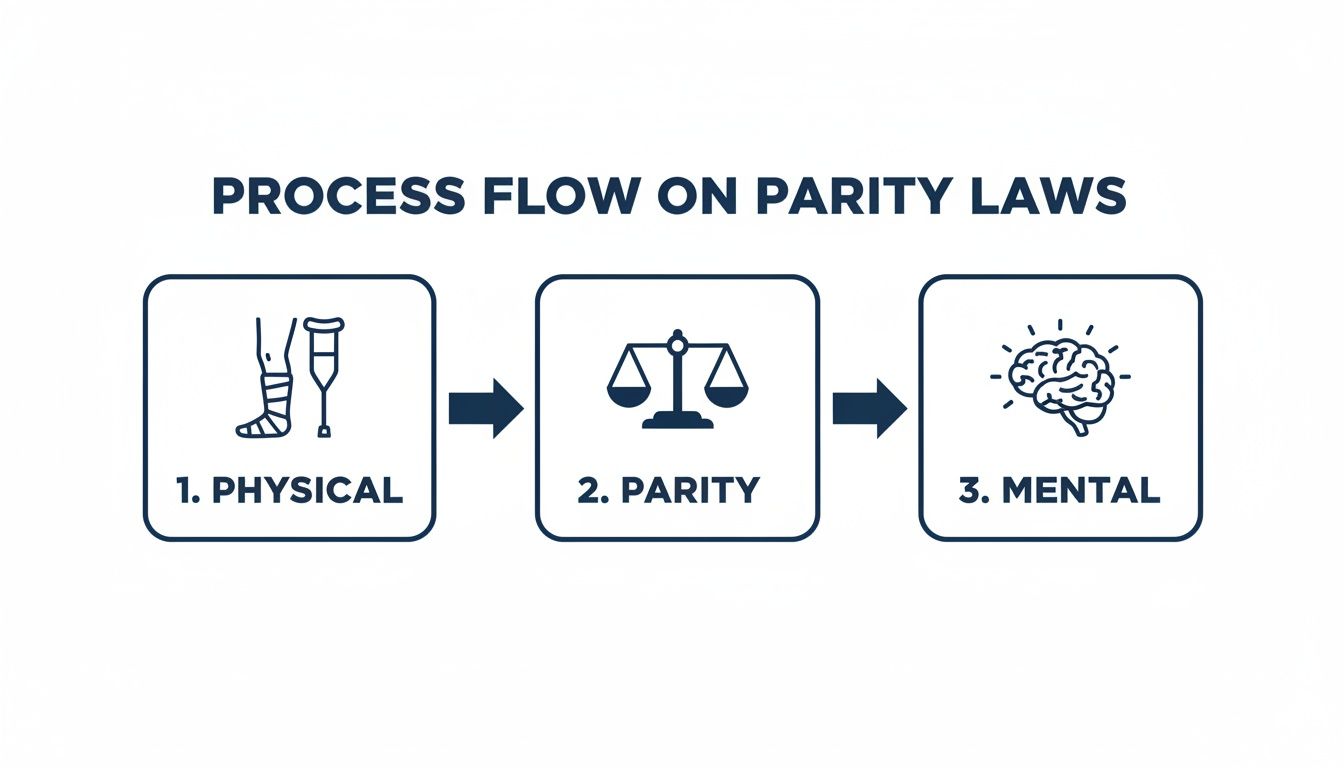
As you can see, the law is the bridge that connects physical and mental healthcare, demanding that insurance companies provide equal access.
The Most Important Questions To Ask Your Insurance Rep
When you get someone on the line, your mission is to pin down the financial details and understand any hoops you might need to jump through. Don't ever hesitate to ask them to repeat something or explain it in simpler terms.
Most importantly, grab a pen and paper. Write down the date, time, and the name of the person you're speaking with. This can be incredibly helpful later.
To make this easier, we've put together a checklist of the crucial questions to ask your insurance representative. Having this in front of you during the call can help you stay on track and ensure you don't forget anything important.
Checklist for Your Insurance Verification Call
| Question Category | Specific Question to Ask | Notes |
|---|---|---|
| Provider Network | Is [Provider Name, e.g., South Shore Recovery Center] considered an in-network provider with my specific plan? | This is the most important first question. The answer changes everything. |
| Key Financials | What is my annual deductible, and how much of it have I already met this year? | |
| Key Financials | What is my out-of-pocket maximum for the year? | |
| Service Costs | Assuming the provider is in-network, what will my copayment or coinsurance be for PHP and IOP services? | You want a dollar amount or a percentage. |
| Authorizations | Does my plan require a prior authorization for these levels of care (PHP/IOP)? | |
| Authorizations | If authorization is needed, who is responsible for getting it—me or the treatment provider? | This clarifies the next steps. |
Getting clear answers to these questions will give you a solid, real-world understanding of your costs and what to expect.
Remember, you are a paying customer. You have every right to get straightforward answers about the benefits you pay for. If you feel lost in the jargon, just say, "Can you explain that to me like I'm not an insurance expert?" It works wonders.
Or… Let the Experts Handle It for You
While you are more than capable of navigating this yourself, you absolutely don't have to. Think about it: the admissions team at a treatment center like ours talks to insurance companies all day, every day. They speak the language, know the codes, and can get accurate information much faster.
Honestly, this is usually the most effective and stress-free path. It takes a huge weight off your shoulders at a time when you already have enough to deal with.
If you want our team to take care of this, the first step is to verify your insurance with us online. The process is completely confidential, comes at no cost, and carries zero obligation. It’s simply about getting you the clarity you deserve.
How to Overcome Common Insurance Roadblocks
Let's be honest: even with strong legal protections on your side, dealing with insurance for addiction treatment can feel like hitting one frustrating roadblock after another. Denials, confusing jargon, and unexpected hurdles are unfortunately common, but they are not the final word.
The key to getting through this is understanding the potential barriers before you hit them. That way, an initial setback doesn’t derail your entire journey to recovery.
Think of it like planning a drive from the Cape to the Berkshires; you know you’re going to hit traffic somewhere. By knowing the common problem spots—like prior authorizations or network restrictions—you can plan your route and keep moving forward without getting stuck.
A Mindset for Overcoming Roadblocks
Before we get into the nitty-gritty, let's start with a clear mindset. Keep these four things in mind as you navigate the process.
- Expect the Hurdles: Terms like 'prior authorization' and 'medical necessity' are going to pop up. Knowing they're a standard part of the process helps take the sting out of it when they do.
- Documentation is Your Best Friend: This is non-negotiable. Keep a log of every single call with your insurer. Jot down the date, time, the representative's name, and a quick summary of the conversation.
- A "No" is Not the End: An initial denial is just the start of a conversation, not the end of the line. You have a legal right to appeal the decision, and a surprising number of denials are overturned.
- You Don't Have to Do This Alone: A good admissions team at a treatment center is your professional advocate. They know the system inside and out and can navigate it on your behalf.
Decoding the Most Common Insurance Hurdles
Let’s break down the three most common roadblocks you're likely to face when trying to get insurance coverage for substance abuse treatment.
1. Prior Authorization
This is simply a checkpoint. It's a requirement from your insurance company to approve a service before you start it. They just want to confirm that the treatment is medically necessary from their perspective. It’s a standard step, not an immediate red flag.
2. Medical Necessity Disputes
Sometimes, an insurer might question if a specific level of care, like a Partial Hospitalization Program (PHP), is truly needed. This is where the clinical documentation from your doctor or treatment provider becomes absolutely critical. It’s the evidence that proves the need for that specific level of care.
3. In-Network vs. Out-of-Network Issues
This is a big one. Using an "in-network" provider means they have a pre-negotiated rate with your insurer, which keeps your out-of-pocket costs low. Going "out-of-network" can lead to massive, unexpected bills because your insurer will only cover a small fraction of the cost, if they cover it at all.

Your Action Plan When You Get a Denial
If your insurance company denies a claim or an authorization request, it's easy to feel defeated. Don’t. Instead, channel that energy into a clear, step-by-step action plan. The appeals process exists for a reason, and it's designed to give you a fair shot.
Step 1: The Internal Appeal
This is your first move. You formally ask the insurance company to take a second look at its own decision. This almost always involves a written request, strengthened by a letter of support from your doctor or treatment provider that explains exactly why the care is medically necessary.
Step 2: The External Review
If the insurance company still says no after the internal appeal, you can take it to the next level. The case gets sent to an independent, third-party reviewer who has no connection to your insurer. This unbiased expert examines all the evidence and makes a final, legally binding decision.
An initial denial is often just an automated response spit out by a computer algorithm. A thoughtful, well-documented appeal forces an actual human to review your case, which dramatically increases your chances of getting the coverage approved.
At South Shore Recovery Center, our team lives and breathes this stuff. We're pros at managing appeals because we understand the specific clinical reasoning and documentation that insurers in Massachusetts need to see. We advocate tirelessly for our clients so they can focus on what matters. You can also explore our flexible payment options and insurance guidance to get a clearer picture of your financial path forward.
Let Our Team Handle the Insurance Process for You
We've covered a lot of ground in this guide, and hopefully, you feel more empowered to understand your insurance coverage. But now it’s time for the most important step: getting help. At South Shore Recovery Center, we believe your focus should be on one thing and one thing only—your recovery. The last thing you need is the stress and frustration of long phone calls with insurance companies.
That's where we come in. Our admissions team, right here in Massachusetts, lives and breathes this stuff. We are experts at untangling the knots of insurance coverage for substance abuse treatment.

Why Let Our Team Help?
Handing the insurance verification over to us brings immediate relief and clarity. Think of us as your personal advocates, ready to navigate the system for you. Here’s what that looks like in practice.
- No-Cost, No-Obligation Verification: We'll verify your insurance benefits completely free of charge and with absolutely no strings attached. It's a simple way we can lift a heavy burden off your shoulders.
- Expert Navigation: Our team is on the phone with insurance providers every single day. We know exactly what to ask, how to interpret the jargon, and how to get a complete picture of what your plan covers.
- A Compassionate Partner: When you call us, you're not just another case number. You’re connecting with a real person who understands what you're going through and is here to guide you with genuine care.
- Fast, Accurate Answers: Because this is what we do, we can get a clear summary of your benefits much faster than you could on your own. This means you can make confident decisions about your care without delay.
Your job is to focus on getting better. Our job is to clear the obstacles standing in your way. Let us take care of the paperwork and phone calls so you can put all your energy into your recovery.
Reaching out is a huge step. Let us make the insurance part easy. Contact our Massachusetts-based team today by phone or through our secure online form to get started.
Frequently Asked Questions
When you're ready to start recovery, the last thing you want is a confusing conversation about insurance. To help clear things up, here are straightforward answers to the questions we hear most often from Massachusetts residents.

Will my employer find out I’m going to treatment?
No. Your privacy is protected by strict federal laws like HIPAA. Your insurance company and your treatment center are legally forbidden from sharing any of your personal health information with your employer unless you give them your explicit, written permission. Your recovery is your business, and it stays confidential.
Does my insurance have to cover rehab?
In most situations, yes. The Affordable Care Act (ACA) lists mental health and substance use disorder services as one of the ten essential health benefits. This means nearly all plans sold on the marketplace, as well as most employer-sponsored and individual plans, must offer this coverage.
What's the main difference between an HMO and a PPO plan?
An HMO (Health Maintenance Organization) is more structured—you must use in-network doctors and facilities and typically need a referral from your primary care physician (PCP) to see a specialist. A PPO (Preferred Provider Organization) offers more flexibility. You can see both in-network and out-of-network providers without a referral, but your out-of-pocket costs will be much lower if you stay in-network.
Does MassHealth cover outpatient programs like PHP and IOP?
Yes, and the coverage is excellent. MassHealth is designed to provide a full continuum of care for substance use disorder, which absolutely includes structured outpatient services like a Partial Hospitalization Program (PHP) or an Intensive Outpatient Program (IOP). As long as these programs are deemed medically necessary, MassHealth generally covers the cost.
How can I find out my exact out-of-pocket costs?
This depends on your specific plan's deductible (what you pay before insurance starts paying), copayments (a fixed fee per service), and coinsurance (the percentage of costs you pay). The only way to know for sure is to verify your benefits. You can do this by calling your insurer directly or by letting our experienced admissions team verify your insurance with us online for a fast, clear, and confidential breakdown of your costs.
