
Loving someone with an alcohol addiction is a painful and isolating journey, but you are not powerless. This guide will provide clear, actionable steps on how to support your spouse without enabling their behavior, set boundaries that protect your well-being, and find effective treatment options in Massachusetts. Remember, your health matters just as much, and taking care of yourself is a critical part of the solution.
Four Key Takeaways From This Guide
- You Can Support, But You Can't Cure. Your power lies not in forcing change, but in setting healthy boundaries, communicating concerns with love, and encouraging professional help.
- Stop Enabling, Start Empowering. Making excuses or shielding your spouse from the consequences of their drinking unintentionally prolongs the addiction. Allowing them to face the real-world impact of their actions is a powerful catalyst for change.
- Self-Care Isn't Selfish—It's Essential. You cannot pour from an empty cup. Seeking your own support through therapy or local Massachusetts groups like Al-Anon is vital for your survival and well-being.
- Professional Help Is Effective. Addiction is a treatable medical condition. Massachusetts offers excellent outpatient programs that use proven, evidence-based therapies to guide people toward lasting recovery.
Recognizing the Signs of Alcoholism in Your Marriage
It often begins with a quiet, persistent feeling that something is wrong. You start noticing small changes that add up over time—unpredictable mood swings, promises that get broken again and again, or a new secretiveness around their drinking habits. If this sounds familiar, you're not alone, and your concerns are likely valid.

Loving someone with an alcohol use disorder (AUD) can feel incredibly isolating. It’s easy to start second-guessing yourself, wondering if you’re just overreacting. But more often than not, there are clear patterns that point to a problem that goes far beyond just "letting off steam" after a tough week.
Beyond Stereotypes: What Problem Drinking Really Looks Like
Forget the old-fashioned stereotypes. Many people with alcohol use disorder are what we call "high-functioning"—they hold down jobs, keep up with friends, and maintain a facade of normalcy. The true signs are often much more subtle and woven into the fabric of your daily life together.
You might be seeing behavioral shifts that have become impossible to ignore:
- Increased Irritability and Mood Swings: Does a minor inconvenience trigger a major outburst, especially if they haven't had a drink in a while?
- Broken Promises and Neglected Responsibilities: Are they consistently forgetting commitments, missing important family events, or letting household duties slide?
- Defensiveness About Drinking: Is any casual question about how much they’ve had to drink met with denial, anger, or attempts to turn the blame on you?
These behaviors slowly erode the trust that holds a marriage together, creating a home environment filled with tension. It’s not about one bad night; it’s about a consistent, damaging pattern.
The Financial and Emotional Toll
Alcoholism never stays in one lane; its impact ripples through every corner of your shared life. You might start noticing unexplained credit card charges or find that savings are dwindling for no clear reason. This kind of financial strain adds a heavy layer of stress and instability to any household.
Emotionally, the distance can feel like a chasm. You may feel less like a partner and more like a caretaker, constantly managing crises or walking on eggshells to keep the peace. Intimacy, both emotional and physical, often fades and gets replaced by worry and resentment.
A Note on Gaining Clarity: Writing things down can be incredibly helpful. Keeping a private journal of specific instances—when a promise was broken, or when drinking led to a fight—isn't about building a case against your spouse. It's about giving yourself clarity and confirming that what you're feeling is based on real, observable patterns.
Identifying Enabling vs. Supporting
There is a razor-thin line between helping someone you love and unintentionally enabling their addiction. Enabling means shielding your spouse from the natural consequences of their choices.
It often looks like:
- Calling their boss with a fake excuse when they're too hungover to work.
- Making excuses to family and friends to cover for their behavior.
- Giving them money for "gas" when you have a sinking feeling it's for alcohol.
Learning to recognize these actions in yourself is the first step toward change. It is also helpful to become more familiar with the full spectrum of behaviors, and you can learn more by reading about the common signs of substance use disorder to better understand your partner's experience. Making the shift from enabling to genuine support is essential—not just for them, but for you. Support means encouraging treatment and honesty, not helping to hide the problem.
How to Have the Conversation About Their Drinking
This is often the hardest part. Just the thought of bringing up your spouse's drinking can feel overwhelming, loaded with the potential for an argument. But letting it go unaddressed only allows the problem to deepen.
The key is to reframe this talk in your mind. This isn't a confrontation; it's an expression of deep concern for someone you love.

Your goal isn't to force a confession or extract a promise to quit right then and there. Think of it more like planting a seed. You're simply opening the door to a dialogue that could, over time, lead to real change. Approaching it with empathy and a clear head makes all the difference.
Choosing the Right Time and Place
Timing is everything. Trying to have this talk when your spouse is drunk, hungover, or when either of you is already angry or rushed is a recipe for disaster. It will almost certainly end in defensiveness and misunderstanding.
Wait for a moment when you are both sober, calm, and have some privacy. This might be over coffee on a quiet weekend morning or during a peaceful evening at home. The setting should feel safe and neutral—like a living room, not an interrogation room.
Using "I Feel" Statements to Express Concern
The words you choose will set the tone for the entire conversation. Steer clear of accusatory language like, "You always drink too much," or "Your drinking is ruining our family." Phrases like that are guaranteed to put them on the defensive and shut down the conversation before it even starts.
A much more effective approach is to frame things from your perspective, using "I feel" statements. It's a simple but powerful communication tool that makes it difficult for them to argue because you're sharing your emotional truth, not attacking them.
-
Instead of saying: "You were a mess at the party last night."
-
Try this: "I felt so embarrassed and worried when you started slurring your words at the party."
-
Instead of saying: "You're spending all our money on alcohol."
-
Try this: "I feel scared when I look at our bank account and see how much is going toward alcohol each week."
This shifts the focus from criticizing their character to showing them the real, tangible impact their drinking has on you—the person they love. This non-confrontational style is a core principle in many therapeutic approaches. You can get a better sense of how it works by reading our guide on what is motivational interviewing therapy.
Preparing for Defensive Reactions
Even if you do everything right, expect some pushback. Denial, anger, and blame-shifting are classic defense mechanisms. You might hear things like, "It's not that bad," or "Well, I wouldn't have to drink if you didn't nag me so much!"
When this happens, the most important thing you can do is stay calm. Don't get drawn into a fight. Your goal is to de-escalate, not to win the argument.
You can gently respond with something like, "I'm not trying to attack you. I'm telling you this because I love you, and I am worried about us."
A Proven Approach: The CRAFT Method
For families struggling with this, the Community Reinforcement and Family Training (CRAFT) model is a game-changer. Unlike old-school, confrontational interventions, CRAFT teaches you to use positive reinforcement.
You learn how to reward sober behavior and allow the natural negative consequences of their drinking to unfold, without shielding them. All the while, the program helps you improve your own well-being. And it works. A comprehensive review found that the CRAFT method helps get a resistant loved one into treatment 68% of the time—a success rate that far surpasses more aggressive strategies.
Key Takeaway: Your first conversation is a starting point, not a magic bullet. By choosing a calm moment, using "I" statements, and being ready for a defensive reaction, you create an opening for change that's built on care, not criticism.
Remember, it may take several of these conversations for the message to truly land. Be patient, stay consistent, and keep showing them that you are on their side—the side that wants them to be healthy, happy, and whole again.
Setting Healthy Boundaries to Stop Enabling
Figuring out how to help an alcoholic spouse often means you have to unlearn behaviors that feel supportive but are actually holding them back. There's a razor-thin line between helping and enabling, and when you cross it, you can accidentally make the problem drag on much longer.
Setting firm, loving boundaries isn't about punishment. It's about protecting your own sanity and emotional health while letting your spouse finally face the real-world consequences of their drinking. This shift is one of the most powerful things you can do. When you stop being a buffer between them and the negative fallout, the need for change can become too obvious for them to ignore.
From Enabling to Empowering
Enabling almost always comes from a place of love. You're just trying to keep the peace. You might call their boss with a vague excuse when they're too hungover to work, give them cash you have a sick feeling is for alcohol, or lie to friends about why they missed a get-together.
These actions feel kind in the moment, but they strip away the very consequences that could be the wake-up call they need. Stopping these habits might feel harsh at first, but it’s a critical step. Empowering them means letting them feel the full weight of their own choices.
Here’s what setting healthy boundaries can look like:
- Saying "no" calmly: When they ask for money, you can say, "I love you, but I can't give you any money. I'm worried about what it will be used for."
- Refusing to make excuses: If they miss work, let them be the one to talk to their boss. Managing their professional life isn't your job.
- Protecting your personal space: Try saying, "I won't be around you when you're drinking. If you start, I'm going to go to another room or leave for a while."
A landmark study revealed a powerful link between a spouse's coping skills and their safety. It found that therapy designed for spouses significantly reduced the likelihood of violence from their alcoholic partners. With intimate partner violence showing up in up to 65% of these situations, learning how to cope effectively is absolutely vital. The numbers also show that while only 25% of people with AUD find lasting sobriety on their own, that number jumps to 75% for those who get treatment. You can explore more findings on addiction and marital health here.
How to Talk About and Stick to Your Boundaries
Bringing up a new boundary needs to be done with calm and consistency. Find a quiet time when they are sober to explain the change. Use "I" statements to make it clear this is about your feelings and needs, not about blaming them. For instance, "I feel incredibly stressed when I have to make excuses for you, so I won't be doing that anymore."
Now, be prepared for pushback. Your boundaries will be tested. They might get angry, try to guilt-trip you, or beg. This is a totally normal reaction when the family dynamic starts to change. The key is to stay strong. Every single time you calmly uphold a boundary, you’re building a new, healthier foundation for your relationship.
Creating a Safety Plan in Massachusetts
For any family in Massachusetts, your safety and the safety of your kids must come first. If your spouse’s drinking ever leads to threatening behavior, emotional abuse, or physical violence, you need to have a safety plan ready. You are not overreacting by preparing for a worst-case scenario.
A good safety plan should include:
- A safe place: Know exactly where you can go on a moment's notice—a friend's house, a relative's apartment, or a local domestic violence shelter.
- An emergency bag: Pack a bag with essentials and hide it somewhere you can grab it quickly. Include clothes, important documents (IDs, birth certificates), spare keys, and some cash.
- A code word: Set up a secret word or phrase with your kids, a trusted friend, or a neighbor. It’s their signal to call for help without alerting your spouse.
- Local resources: Save the number for a local domestic violence hotline, like Jane Doe Inc. here in Massachusetts, in your phone. If you are ever in immediate danger, do not hesitate—call 911.
Setting and sticking to these boundaries is tough. It might be one of the hardest things you do. But it's an act of self-preservation that also gives your spouse the best possible shot at getting better.
Finding the Right Treatment in Massachusetts
When your spouse finally says "yes" to getting help, you might feel a wave of relief followed by a fresh wave of panic. What now? The world of addiction treatment can feel like a maze, but the good news is that here in Massachusetts, you have options—really good, effective options that don't always mean uprooting your entire life.
Most people's minds jump straight to residential rehab, picturing a 30-day stay somewhere far away. While that's the right path for some, it's far from the only one. For many, outpatient care is a more practical and equally powerful choice. It allows your spouse to get the intensive help they need while still coming home at night, going to work, and being part of the family. That continuity can make all the difference.
What Outpatient Care Actually Looks Like
"Outpatient" isn't a one-size-fits-all term. It's a spectrum of care designed to meet people where they are. Think of it as different levels of support that can be adjusted as your spouse makes progress.
Here are the most common structures you'll see in Massachusetts:
- Day Treatment Programs (DTP): Also known as Partial Hospitalization Programs (PHP), this is the highest level of outpatient care. It's a serious commitment, often involving treatment for several hours every weekday. It provides the structure of a residential program without the overnight stay.
- Half-Day Treatment Programs (HDTP): A step down from DTP, these are often called Intensive Outpatient Programs (IOP). They offer a solid block of therapy for a few hours a day, a few times a week. Many programs have morning or evening sessions, making it possible to schedule around work or other responsibilities.
- Standard Outpatient (OP): This is the most flexible and least intensive option, usually consisting of one or two therapy sessions a week. It’s perfect for someone who has already completed a more intensive program or whose situation is less severe but still requires professional support.
Recovery is a journey, and it often involves moving through these different levels of care over time. Getting a feel for the landscape is the first step, and looking into a good resource on alcohol rehab in Massachusetts can help clarify what each program entails and which might be the best starting point.
This chart can also help clarify the difference between actions that are genuinely helpful versus those that might be enabling the problem.
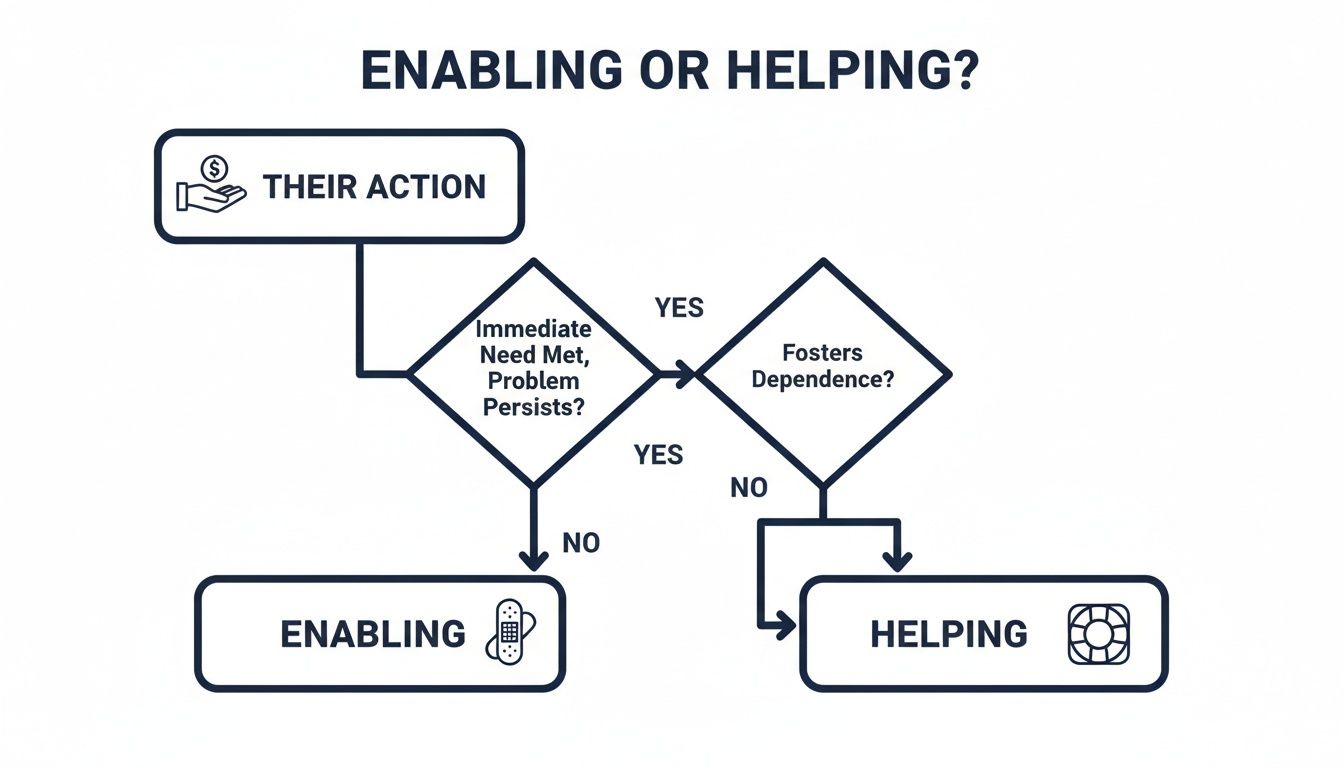
As you can see, true help is about fostering independence and long-term health, while enabling often tackles a short-term crisis in a way that allows the addiction to continue.
The Hallmarks of a Quality Program
As you start looking at different centers, you'll come across a lot of clinical terminology. Don't let it intimidate you. Knowing a few key terms will help you spot the programs that use proven, effective methods.
Here’s what to look for:
- Dual Diagnosis Care: It is incredibly common for addiction to walk hand-in-hand with mental health struggles like anxiety, depression, or trauma. A program that offers dual diagnosis care is equipped to treat both at the same time, which is essential for any real chance at lasting recovery.
- Evidence-Based Therapies: You want a program grounded in science, not just good intentions. Look for therapies like Cognitive Behavioral Therapy (CBT) and Dialectical Behavior Therapy (DBT). These are the gold standards for helping people change their thinking, build healthy coping skills, and learn to manage emotions without alcohol.
- Medication-Assisted Treatment (MAT): For alcohol use disorder, several FDA-approved medications can be a game-changer for reducing cravings and supporting sobriety. When used alongside therapy, MAT can dramatically increase a person's odds of success.
- Family Therapy: Addiction doesn't happen in a vacuum—it affects the whole family. Research has consistently shown that involving the family, especially the spouse, leads to better outcomes. One review highlighted that Behavioral Couples Therapy (BCT) not only helped reduce drinking but also decreased domestic violence more effectively than individual therapy alone. With modern data showing that 90% of people with alcoholism may relapse without strong support, your involvement is more critical than ever.
Your Role in This: Your job is to be a supportive partner, not a case manager. Do a little legwork—find a few accredited, local programs that seem like a good fit. Then, when the time is right, you can approach your spouse with a sense of collaboration. Try saying something like, "I found a couple of places that look really good and I've already checked that they take our insurance. Would you be willing to just look at their websites with me?" This approach is about teamwork. It takes a huge logistical and emotional weight off their shoulders and shows them you’re ready to walk this path with them.
Why Your Own Self-Care Is Non-Negotiable
When you're trying to help a spouse who’s struggling with alcoholism, it can feel like you're caught in a storm with no end in sight. The constant worry, the broken promises, the chaos—it's emotionally and physically exhausting. Many partners describe a profound sense of isolation and chronic stress.
You simply cannot pour from an empty cup. If you're running on fumes, you won't have the strength, clarity, or resilience to be a positive force for anyone, including yourself. This is why self-care isn't a selfish indulgence; it's a critical part of your survival strategy.

This part of the guide is dedicated entirely to you. It's about giving yourself permission to take a step back, recharge, and rediscover your own sense of self. Taking care of your own health is truly the most powerful thing you can do for yourself and your family right now.
Reconnecting With Yourself
It’s incredibly common for your own identity to get lost when you love someone with an addiction. Your hobbies, friendships, and dreams often get pushed aside as managing the crisis becomes your life’s focus. Reclaiming those pieces of yourself is not just okay; it's absolutely essential.
Think back. What brought you joy before your life became consumed by this? Was it painting, hiking, or just meeting a friend for coffee without looking at your phone? Start small. Try to carve out just 30 minutes a day for something that is entirely for you.
This isn't about ignoring the problem. It's about reminding yourself that you are a whole person, separate from your spouse's illness. Doing so replenishes your emotional reserves, which gives you the strength to face challenges with a much clearer head.
The Power of Professional Support
You were never meant to carry this weight alone. Finding a therapist for yourself provides a safe, confidential space to unpack the complicated mix of anger, grief, and confusion you're likely feeling. A good therapist can give you practical coping skills and help you maintain the healthy boundaries you're working so hard to set.
Many people find that even if their partner refuses to get help, their own therapy makes a world of difference. It can dramatically reduce their stress levels and improve their quality of life. Think of it as a lifeline—objective, professional support when you feel like you're drowning.
One of the most powerful concepts you can learn is how to detach with love. It's about learning to separate the disease of alcoholism from the person you love. It means you can still care for them deeply without letting their choices and their illness destroy your own peace of mind.
Finding Your Community in Massachusetts
The isolation that comes with a spouse's addiction can be crushing. Support groups connect you with a community of people who genuinely get it because they are walking a similar path. It's a judgment-free zone where you can finally share your story and learn from the experiences of others.
Here in Massachusetts, you can find local meetings for fantastic groups like:
- Al-Anon: This is a well-known fellowship specifically for the friends and family of people with alcoholism. Its core philosophy is a powerful reminder: you didn't cause it, you can't control it, and you can't cure it.
- SMART Recovery Family & Friends: This is a science-based alternative to 12-step programs. It offers practical tools to help you manage your own emotional reactions and find ways to encourage your loved one toward recovery without enabling their behavior.
Joining a group breaks down that wall of isolation. Hearing other people’s stories is incredibly validating and gives you practical strategies that have actually worked for others in your shoes.
Frequently Asked Questions
When you’re trying to help a spouse struggling with alcoholism, you’re bound to have a million questions running through your mind. It’s a confusing and lonely place to be. Here are some straightforward, honest answers to the questions we hear most often from families just like yours.
What if my spouse won't admit they have a problem?
Denial is one of the most common signs of addiction. It's a defense mechanism, not a reflection of their character. Trying to argue or reason them into admitting they have a problem almost never works and usually just creates more conflict. Instead of focusing on the label "alcoholic," try to talk about specific behaviors and how they make you feel. Use "I feel" statements, like "I feel scared when you drive after drinking." At the same time, stick to your boundaries and keep getting support for yourself. Sometimes, the most powerful motivator for change is seeing you get healthier and refusing to participate in the chaos any longer.
Can our marriage survive this?
Yes, it absolutely can. Many couples find their way back to each other and build a stronger, more honest relationship than before. But it doesn't happen by accident. It takes a serious commitment from both of you. One person has to commit to the real work of recovery, and the other has to commit to supporting them while also protecting their own sanity and well-being. This is where professional help becomes invaluable. Couples counseling with a therapist who specializes in addiction can create a safe space to heal, rebuild shattered trust, and learn how to talk to each other again.
When should I think about leaving?
This is an incredibly painful and personal decision, and there's no single right answer. Your safety, and the safety of any children, must always come first. If your spouse's drinking has led to any kind of abuse—be it emotional, verbal, financial, or physical—you need a safety plan, and you may need to leave. If you’ve tried everything, set firm boundaries that are constantly ignored, and see no real effort to change, you may reach a point where separation is the only healthy choice. This isn't giving up; it's an act of self-preservation. You have to save yourself.
What do I do if they relapse?
Relapse feels devastating, but it doesn't erase all the progress they've made. It’s often a part of the long-term recovery process, not a sign of complete failure. The best thing you can do is offer support without judgment and immediately encourage them to reconnect with their treatment team, sponsor, or support group. This is also a crucial time to double down on your own boundaries. Don't shield them from the consequences. Lean on your own support system—your therapist, Al-Anon meetings, and trusted friends—to help you get through it.
