
Loving someone with an alcohol addiction is a painful and isolating journey. You may feel lost, wondering how to help them without losing yourself. This guide provides actionable steps and compassionate advice for navigating this difficult path, with a focus on resources available here in Massachusetts. Taking the right first steps can create a foundation for a healthier future—for both of you.
4 Key Takeaways for Helping an Alcoholic Spouse
- Educate Yourself & Prioritize Safety: Understand that Alcohol Use Disorder (AUD) is a medical condition, not a moral failing. Your first priority is the physical and emotional safety of yourself and any children.
- Stop Enabling & Set Boundaries: Unintentionally shielding your spouse from the consequences of their drinking (making excuses, providing money) prolongs the addiction. Setting firm, loving boundaries is crucial for your well-being and their potential recovery.
- Seek Your Own Support: You cannot do this alone. The emotional toll is immense. Groups like Al-Anon and professional therapists provide essential support and coping strategies specifically for families affected by alcoholism.
- Explore Local Treatment Options: When they are ready, understand the different levels of care available. Outpatient programs in Massachusetts offer effective treatment while allowing your spouse to remain at home.
Your First Steps When a Spouse Is Drinking Too Much
Your first instinct might be to try and fix everything—to plead, bargain, or lay down ultimatums. I’ve seen it countless times. But the most effective approach actually starts with you, not them. It’s less about controlling their behavior and more about creating an environment where they can finally see the consequences of their actions, all while you protect yourself from the fallout.

Before you have a single conversation or think about an intervention, it's critical to ground yourself with a clear mindset. The following table breaks down the immediate actions and mental shifts you need to make right now.
Four Key Takeaways For Helping Your Spouse
| Takeaway | Why It's Important | First Action Step |
|---|---|---|
| Educate Yourself First | Understanding replaces fear. Seeing Alcohol Use Disorder (AUD) as a medical condition, not a moral failing, helps you approach the problem with compassion instead of anger. | Read a few articles from trusted medical sources about AUD and how alcohol physically changes the brain. |
| Prioritize Your Safety | Addiction can make a person’s behavior erratic and unpredictable. Your well-being and that of any children in the house is non-negotiable. | Have a safety plan. Know who you can call and where you can go if you ever feel unsafe, even just for a night. Identify a trusted friend or local Massachusetts resource. |
| Stop Enabling Behavior | Making excuses, lying for them, or cleaning up their messes shields them from the natural consequences of drinking. This unintentionally prolongs the addiction. | The next time they’re too hungover for a family gathering, don't make an excuse for them. If asked, state the facts calmly and without judgment. |
| Seek Your Own Support | You cannot pour from an empty cup. Loving someone with an addiction is emotionally draining, and you need your own space to process and heal. | Find a local Al-Anon meeting in the South Shore area or book an appointment with a therapist who understands family addiction dynamics. |
Making these shifts is a powerful first move. It helps you step out of the cycle of chaos and into a position of strength and clarity, which is exactly where you need to be.
Recognize the Reality of the Situation
Forget the stereotypes. Alcohol Use Disorder doesn't always look like someone drinking from a paper bag. More often, the signs are woven into the fabric of your daily life.
You might be noticing things like:
- Increased Secrecy: Finding hidden bottles in the garage, noticing them drinking alone after you've gone to bed, or catching them in lies about how much they’ve really had.
- Unpredictable Moods: Sharp, confusing shifts from happy and affectionate to angry or withdrawn, especially when alcohol is—or isn't—available.
- Neglected Responsibilities: They start missing work deadlines, forgetting to pick up the kids, or letting important household tasks slide.
- Loss of Interest: They’re slowly pulling away from hobbies, friendships, or family time that they used to love.
It's essential to understand that you did not cause their drinking, you cannot control it, and you cannot cure it. Your role is not to be their savior but to be a supportive partner who encourages them to seek professional help while protecting your own well-being.
It can be incredibly helpful to start documenting specific examples. This isn't about building a case to use against them in a fight. It’s for your own clarity on days when you feel confused or when they try to gaslight you by minimizing the problem.
For instance, writing down, "Tuesday, you missed our daughter's soccer game because you were passed out" is a concrete fact. It’s much more powerful and clear than a vague, emotional accusation like, "You always let us down!"
Taking the time to understand how addiction affects the family is a crucial step. It helps you see the unhealthy patterns you've both fallen into and gives you a roadmap for creating healthier ways to interact. Remember, taking care of yourself isn’t selfish—it's the most constructive thing you can do for everyone.
How to Talk About Their Drinking Without Starting a Fight
Knowing you need to have "the talk" about your spouse's drinking is one thing. Actually starting that conversation can feel impossible. The fear of triggering an argument, denial, or a complete shutdown is completely valid. But if you plan the conversation carefully and lead with concern instead of accusation, you can open a door to dialogue instead of slamming it shut.
The goal here isn't to win an argument or force a confession. It’s about planting a seed. You want to express your love and concern in a way your partner can actually hear, and that requires being strategic about when, where, and how you bring it up.

Choose Your Moment Wisely
Timing and setting are everything. Trying to talk about their drinking while they're intoxicated or hungover is a recipe for disaster. The conversation will go nowhere, and they probably won't remember it clearly anyway.
Instead, you have to pick a moment of calm and sobriety. Find a time when you’re both relatively relaxed and won't be interrupted. A private, neutral space is key—the living room couch is far better than the bedroom, which can feel too intimate and confrontational. A quiet Saturday morning might be the right time, not a stressful Tuesday night after a long day at work.
Frame the Conversation with "I" Statements
This is the single most important change you can make in how you communicate. It’s a simple but powerful shift from accusation to expression. The idea is to talk about your feelings and your experience, which are facts they can't argue with.
Here’s what that looks like in practice:
- Instead of: "You always drink too much and embarrass me."
- Try: "I feel scared and lonely when you've been drinking heavily."
- Instead of: "You're ruining our family with your drinking."
- Try: "I'm worried about how the drinking is affecting the kids and our relationship."
When you use "I" statements, you're not attacking them; you're sharing your reality. It makes it much harder for them to get defensive and can gently help them see how their actions are impacting the people they love.
The point isn't to force an immediate admission of guilt. It's about honestly sharing your feelings to create a small opening for them to see their behavior through your eyes. This is a compassionate, non-confrontational method that mirrors many successful therapeutic approaches.
Prepare for a Defensive Reaction
Even with the most thoughtful approach, your spouse will likely react with anger, denial, or even blame. Be prepared to hear things like, "You're overreacting," or "The only reason I drink is because you're always on my case." Expect this, and make a plan to not get pulled into a fight.
Your job is to remain calm and stick to your message of concern. If they get defensive, you can respond with something like, "I'm not trying to start an argument. I just need you to hear how I'm feeling because I love you and I'm worried." If the conversation truly escalates, it's okay to press pause. Simply say, "Maybe now isn't the best time. Let's talk about this later."
This is rarely a one-and-done conversation. The techniques here are actually similar to principles used in professional therapy. You can learn more about Motivational Interviewing therapy (https://southshorerecovery.com/what-is-motivational-interviewing-therapy/), which is a powerful way to help people find their own reasons to change. Understanding these strategies can give you insight into what makes a more productive dialogue. Your persistence and calm are your best tools for showing them a path forward.
Setting Healthy Boundaries to Protect Yourself
When you love someone struggling with alcoholism, the idea of setting boundaries can feel like the opposite of helping. It might even feel cruel. But I can tell you from experience, it’s one of the most powerful and loving things you can do—for your spouse, and just as importantly, for yourself.
Think of boundaries not as punishments, but as guardrails for your own well-being. They’re about self-preservation. They stop you from being pulled under by the chaos of addiction and break the cycle of enabling that, unintentionally, keeps the addiction alive and well.
By setting firm, clear limits, you allow your partner to finally face the natural consequences of their drinking. Sometimes, that’s the only thing that can break through the denial. It’s a way of saying, “I love you deeply, but I will no longer be a part of this.”
What Do Practical Boundaries Actually Look Like?
So, what does this look like in the real world? It means you consciously stop doing the things that soften the blow of their addiction. You have to shift your role from caretaker of their addiction to a supporter of their recovery.
Here are some real-world examples I've seen partners successfully put in place:
- No more covering for them. Stop calling their boss to say they have the "flu" when they're hungover. It’s hard, but it’s a crucial step.
- Don't fund the addiction. You can calmly state that your money, whether it’s from a joint account or your own paycheck, will no longer be used to buy alcohol.
- Let them clean up their own messes. This applies to everything from physical messes after a binge to the social fallout, like apologizing to family for their behavior at a gathering.
- Refuse to participate in risky situations. You have every right to leave a party if their drinking gets out of hand or to skip events where you know heavy drinking is the main activity.
Setting a boundary is an act of profound love. It tells your partner, "I believe you are strong enough to take responsibility for your life," and it tells yourself, "My well-being is not negotiable." This isn't about control; it's about creating clarity in the chaos.
Getting Past the Guilt and Sticking to Your Guns
Let’s be honest: when you first enforce these boundaries, the guilt can be overwhelming. Your spouse might get angry, accuse you of abandoning them, or try to manipulate you. Please know this is a completely normal reaction—from both of you. You are changing the entire dynamic of the relationship.
The emotional toll on partners is staggering. One study revealed that a shocking 48% of wives of individuals with Alcohol Dependence Syndrome reported severe psychological distress. Many also face a higher risk of domestic violence. This isn't just a small side effect; it's a serious danger that makes your self-care and safety non-negotiable. You can read the full research on the impact on spouses to see just how common these struggles are.
To navigate the guilt, you need your own team. A therapist or a support group like Al-Anon can be a lifeline, giving you a safe place to talk without judgment. On tough days, it can also help to have your boundaries written down somewhere, along with why you set them. It’s a powerful reminder to stay the course.
How to Talk About Your New Rules
The final step is telling your spouse about these boundaries. The key is to do it calmly and clearly, without anger or blame.
Try using "I" statements. This keeps the focus on what you need and what you will do, rather than what they are doing wrong.
For instance, instead of shouting, "You have to stop making me lie for you!", try this: "I can't make excuses to your work anymore when you've been drinking. For my own peace of mind, I need to be honest." See the difference?
Prepare yourself, because you will have to uphold these boundaries over and over again. Consistency is everything. It shows your spouse that you are serious and that the old rules no longer apply. This isn’t an ultimatum designed to punish, but a necessary step to protect yourself and, hopefully, create the space for their recovery to begin.
Finding the Right Treatment Options in Massachusetts
When your spouse finally agrees they need help, it's a monumental step. That initial flood of relief, however, is often followed by a daunting question: What's next? The world of addiction treatment is full of confusing acronyms and different programs, which can feel completely overwhelming when you're already running on empty.
Understanding the local options here in Massachusetts is the key to moving forward effectively. It's about finding a path that fits your life, not just a generic solution.
The most important thing to know is that recovery isn't a one-size-fits-all process. Different levels of care exist to meet people exactly where they are. For many, outpatient treatment is a powerful option because it provides the necessary structure and therapy while allowing them to stay connected to their job, family, and home.
Getting to Know Outpatient Care in the Bay State
Here in Massachusetts, especially around the South Shore and Greater Boston, you’ll find several excellent outpatient programs. These aren't residential facilities where your spouse would live. Instead, they offer structured, professional support for a set number of hours and days each week.
Let's break down the common types you’ll encounter:
- Partial Hospitalization Program (PHP): This is the most intensive form of outpatient care. Think of it as a full-time commitment during the day, making it a great step-down from an inpatient stay or a strong starting point for someone who needs daily support but has a stable home to return to.
- Intensive Outpatient Program (IOP): An IOP offers a bit more flexibility. It still provides a robust, therapeutic structure but with a smaller weekly time commitment than a PHP.
- Standard Outpatient Program (OP): This is the most flexible option, typically involving just one or two therapy sessions a week. It’s best for those who have already completed a more intensive program or whose alcohol use disorder is less severe and have a strong support network.
It's also worth noting how isolating this experience can be for the supporting spouse. Historically, many treatment models have focused solely on the person with the addiction, leaving partners feeling invisible. But that's changing. More and more, research shows that including family in therapy is far more effective for everyone, helping to rebuild trust and heal the relationship. You can read more about the lived experiences of spouses to see just how deep these dynamics go.
Setting your own boundaries is also a critical part of this process. It's not about being harsh; it's about protecting yourself and refusing to enable the addiction.
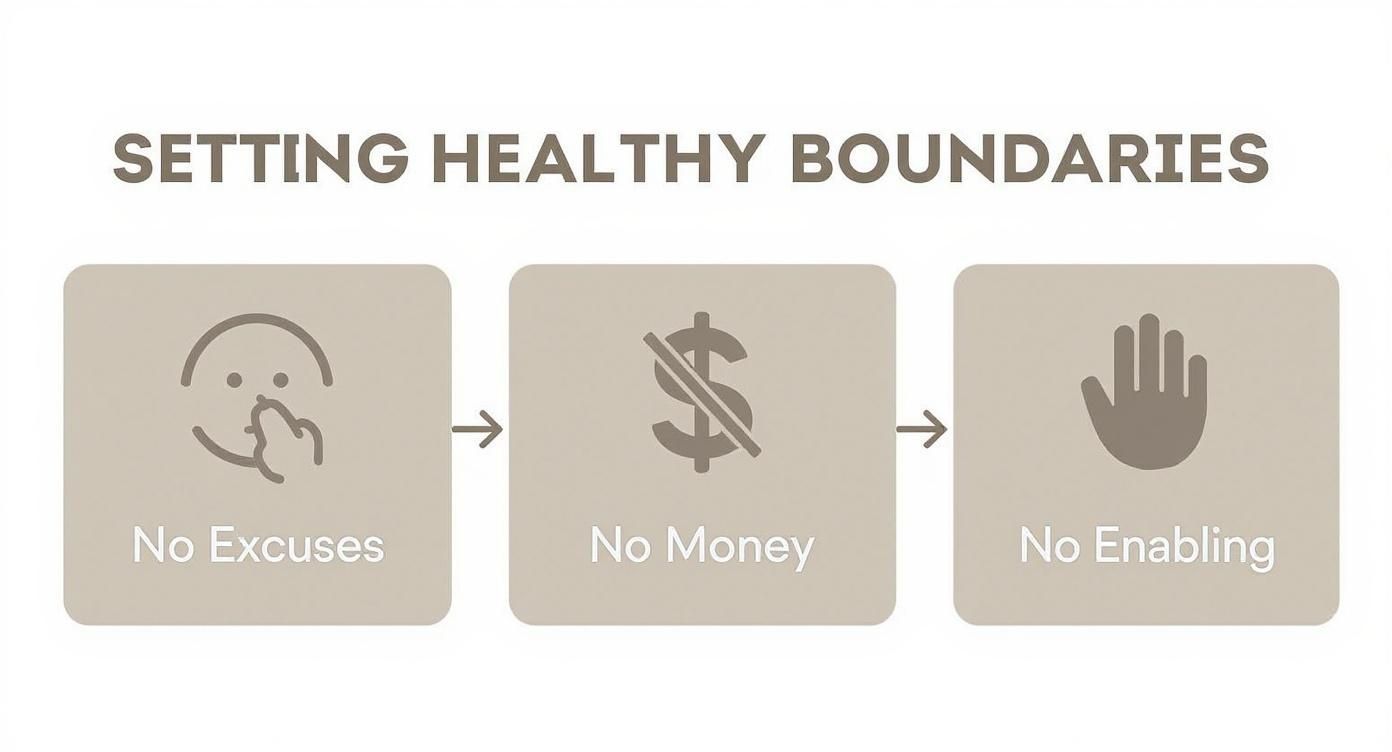
These principles—no making excuses, no providing money for alcohol, and no covering up consequences—are acts of love for both your spouse and yourself.
How to Choose the Right Program for Your Spouse
So, which program is the right one? The answer depends entirely on your spouse’s specific situation. Someone who is medically stable but can't seem to string together sober days on their own might be a perfect fit for a PHP. On the other hand, someone who absolutely must keep their full-time job might find that an IOP provides that ideal blend of support and real-world flexibility.
One crucial point: stopping drinking suddenly can be incredibly dangerous. Before anything else, you need to understand the risks. It's vital to get familiar with alcohol withdrawal symptoms and the necessary treatment to make sure this process is managed safely.
The most important thing is that you don't have to figure this out alone. Reputable treatment centers in Massachusetts offer free, confidential assessments to help you determine the right level of care. This is your opportunity to get expert guidance from people who do this every day.
To help clarify the options, here's a simple breakdown of the outpatient programs you'll find locally.
Comparing Outpatient Treatment Programs in Massachusetts
Understanding the different levels of outpatient care is the first step in finding the best fit for your spouse's unique needs and circumstances.
| Program Type | Typical Time Commitment | Best Suited For |
|---|---|---|
| Partial Hospitalization (PHP) | 5-6 hours/day, 5 days/week | Individuals needing intensive daily support but with a stable home environment; often a step-down from inpatient care. |
| Intensive Outpatient (IOP) | 3 hours/day, 3-5 days/week | People who require structured therapy but need to maintain work, school, or family schedules. |
| Standard Outpatient (OP) | 1-2 hours/week | Those with a mild AUD or who are stepping down from a higher level of care and need ongoing support to maintain sobriety. |
Each of these programs offers a different intensity of support. The goal is to match the program to the person, not the other way around.
Taking the First Step With a Local Center
I know that first phone call can feel heavy. It’s a big step. But it’s also a concrete, positive action you can take right now.
When you contact a local resource like South Shore Recovery Center, for example, you’ll be connected with someone who gets it. The call is completely confidential and is all about understanding your family's situation.
You can expect to talk with a caring admissions coordinator who will ask about your spouse’s drinking patterns, any other mental health concerns, and the challenges you're facing. They can help you figure out insurance benefits and explain what the next steps look like, all without any pressure. Think of it as simply gathering the information you need to open the door to real, professional help right in our community.
Why You Need Your Own Support System
So much of this journey has revolved around your spouse and their struggle with alcohol. But let's pause and shift the focus to you. It’s a cliché because it’s true: you simply can't pour from an empty cup. Loving someone battling an addiction is emotionally draining, and taking care of yourself isn’t selfish—it’s a necessary act of survival.
This path is as much about your own health and sanity as it is about their recovery. You absolutely need your own support system to navigate your feelings, find better ways to cope, and gather the strength to keep going.
Find a Safe Space to Process Your Experience
Life with an alcoholic spouse is often a rollercoaster of stress, broken promises, and profound disappointment. It's vital to have a safe outlet where you can talk about all of it without judgment or worrying that you'll make things worse at home.
This is where support groups and therapy can become genuine lifelines. They create a space that is one hundred percent for you.
- Al-Anon: This is a fellowship created specifically for the friends and family of alcoholics. In a local Massachusetts Al-Anon meeting, you’ll be surrounded by people who know exactly what you're going through because they’re living it, too. It’s a place to share your story and gain perspective from others who have walked in your shoes.
- Individual Therapy: Working with a therapist who specializes in addiction's impact on families can be incredibly helpful. They can help you unpack complicated emotions, recognize codependent behaviors you may have unknowingly adopted, and create a solid plan for setting healthier boundaries.
Seeking your own support is not a sign of weakness; it's a strategic move for your own mental health. It gives you the tools and the emotional reserves needed to handle the challenges of your spouse's addiction without losing yourself in the process.
Learn to Detach with Love
One of the most powerful ideas you'll encounter in groups like Al-Anon is learning to "detach with love." This doesn't mean you stop caring or turn your back on them. It means learning to emotionally separate yourself from their drinking and the chaos it creates.
Detaching with love is about accepting that you can't control their addiction, but you can control how you respond to it. It’s about letting go of the constant anxiety and the exhausting attempts to manage their life. This is how you protect your own peace of mind while still holding on to compassion for the person you love.
Prioritize Real Self-Care Practices
Let's be clear: self-care here goes way beyond bubble baths. It’s about the intentional, sometimes difficult, work of rebuilding your own life and identity outside of your partner’s addiction. For a long time, their illness has likely been the center of your universe. It's time to reclaim your own space.
Real, practical self-care could look like:
- Reconnecting with Friends: Carve out time for the people who lift you up. You need to be reminded of who you are apart from your role as a caretaker.
- Rediscovering Hobbies: What did you love to do before this all took over? Painting, hiking, reading, music—find your way back to activities that bring you genuine joy.
- Practicing Mindfulness: Even simple breathing exercises or a 5-minute meditation can help you hit the reset button on the daily stress and anxiety.
The psychological toll on spouses is immense. In fact, research shows that many partners resort to emotional withdrawal just to get through the day. This emotional distancing is a huge red flag, signaling a need for dedicated mental health support and healthier coping strategies. You can explore the research on spousal coping mechanisms to better understand these patterns.
Build a Resilient Future for Yourself
Here's the hard truth: your well-being cannot depend on whether or not your spouse gets sober. While you absolutely hope for their recovery, you have to build a life for yourself that is stable and fulfilling no matter what they choose.
This means putting energy back into your own goals, your career, your friendships, and your health. When you build this strong foundation, you become better equipped to support your spouse if they choose recovery. And just as importantly, you'll be prepared to protect yourself if they don’t. Putting your own health first is the most powerful thing you can do—for both of you.
Frequently Asked Questions
Living with a spouse's alcoholism means living with a constant barrage of questions. Am I doing the right thing? Am I making it worse? What if they never stop? These questions can circle in your head, making an already overwhelming situation feel impossible. Here are answers to some of the most common concerns.
What if my spouse refuses to get help?
This is one of the most painful realities of this disease. You cannot force someone into treatment. Your energy is much better spent on what you can control: setting firm boundaries, protecting your own well-being (and that of any children), and seeking your own support through therapy or groups like Al-Anon. Sometimes, allowing your spouse to experience the full, natural consequences of their choices is the only thing that can spark a desire for change.
Is it my fault that my spouse drinks so much?
No. Absolutely, unequivocally not. Alcoholism is a complex disease with roots in genetics, trauma, and a person's environment. You did not cause it, you cannot control it, and you cannot cure it. It's common to feel responsible, but that guilt is a destructive weight. Their drinking is their responsibility, not a reflection of your worth as a partner.
Should I leave my alcoholic spouse?
This is a deeply personal decision that no one else can make for you. Your first priority must always be safety. If there is any kind of physical, emotional, or verbal abuse, your focus needs to be on creating a safety plan to protect yourself and your children. If abuse isn't a factor, the decision depends on your emotional capacity, your spouse's willingness to change, and what you need to live a healthy, fulfilling life. A therapist can be an invaluable ally in navigating this difficult choice.
What are the first signs of alcoholism in a spouse?
Early signs can be subtle. Look for patterns like increasing secrecy around drinking, unpredictable mood swings, neglecting responsibilities at work or home, and losing interest in hobbies or friendships they once enjoyed. They may also become defensive or angry when you bring up their drinking. Trust your gut—if you feel something is wrong, it's worth paying closer attention.
