
Cognitive Behavioral Therapy (CBT) is a practical, goal-focused type of psychotherapy that helps people learn how to spot and change the destructive thought patterns and behaviors that fuel addiction. Its power lies in a simple but profound idea: our thoughts, feelings, and actions are all connected. For those seeking help in Massachusetts, understanding how CBT works is the first step toward lasting change.
Key Takeaways
- CBT Connects Thoughts to Actions: It teaches you how your negative thoughts directly influence your actions, particularly the choice to use substances, and empowers you to interrupt this cycle.
- It Focuses on Practical Skills: CBT is not just talk therapy; it equips you with tangible tools like cognitive restructuring and behavioral experiments to manage cravings and handle real-world triggers.
- It's a Proven, Evidence-Based Approach: Backed by extensive scientific research, CBT is a trusted method used by addiction specialists for its effectiveness in treating substance use and co-occurring disorders like anxiety and depression.
- Local, Accessible Treatment is Available: In Massachusetts, programs like Partial Hospitalization (PHP) and Intensive Outpatient (IOP) integrate CBT, allowing you to receive high-quality care while living at home.
Understanding CBT and Its Role in Addiction Recovery
When it comes to treating substance use disorders, Cognitive Behavioral Therapy is one of the most trusted and proven methods out there. Instead of digging deep into your past, CBT for addiction is all about the here and now. It gives you real-world tools to manage cravings, navigate triggers, and start building a healthier life today.
The core concept is pretty easy to grasp. Addiction often runs on a self-repeating loop: a negative thought pops up, which triggers a painful feeling, which then leads to using a substance to cope. CBT is designed to help you step out of that loop entirely. It’s not about assigning blame; it’s about building self-awareness and learning a new way to respond.
For a more in-depth look, feel free to explore what is cognitive behavioral therapy on our blog.
This model shows just how tightly our thoughts, feelings, and actions are linked.
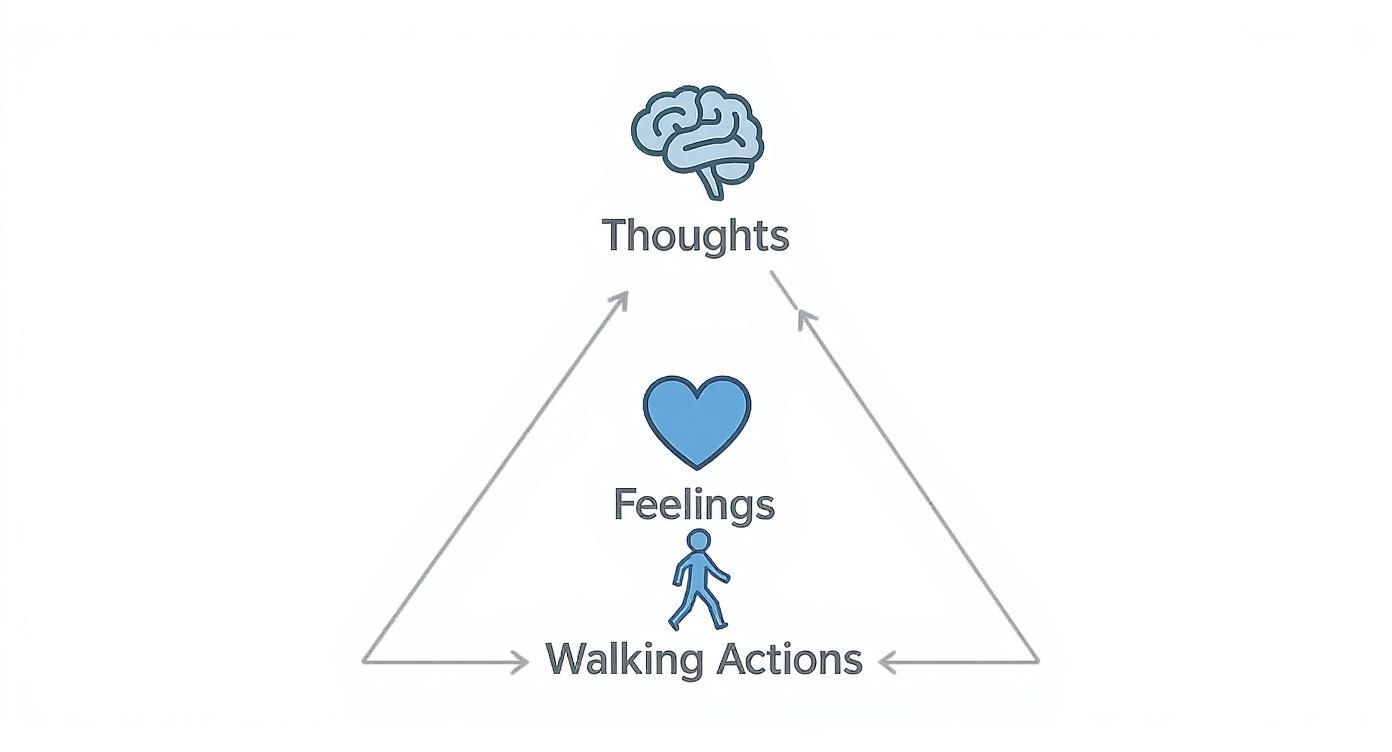
This cycle is what keeps addiction going. A stressful thought can spark intense anxiety, which in turn leads to the action of using a substance for relief—a loop that CBT is expertly designed to break.
How CBT Breaks the Addiction Cycle
Addiction rarely just happens. It follows a predictable pattern that can feel impossible to break free from. For so many people we see here in Massachusetts, simply understanding this cycle is the first real step toward getting well. CBT works by intervening at each stage of that cycle, giving you a new path forward.
CBT provides the tools individuals need to not just stop using substances, but to stay sober and rebuild their lives. It's about developing the skills for long-term self-management and resilience.
To really see how this works, it helps to break the addiction cycle down into clear steps. The table below shows what's typically happening at each stage and, more importantly, how CBT provides a direct, practical intervention.
How CBT Interrupts the Cycle of Addiction
| Stage | Typical Experience in Addiction | CBT Intervention |
|---|---|---|
| Trigger | Experiencing a high-risk situation, like stress at work or seeing old friends who use. | Functional Analysis: You learn to identify your unique triggers and understand exactly why they lead to cravings. |
| Thought | An automatic negative thought pops up: "A drink is the only thing that will help me relax." | Cognitive Restructuring: You're taught how to catch that unhelpful thought, challenge its validity, and replace it with a more balanced one. |
| Feeling | The thought triggers an intense craving, anxiety, or some other form of emotional distress. | Coping Skills Training: You practice techniques like mindfulness or deep breathing to manage the uncomfortable feeling without needing to escape it with a substance. |
| Action | Giving in to the craving and using, which reinforces the entire cycle for next time. | Behavioral Strategies: You use a pre-planned, healthy activity—like calling a sponsor, going for a walk, or listening to music—to replace the act of using. |
By breaking the process down like this, CBT makes recovery feel so much less overwhelming. It takes that powerful, out-of-control cycle and turns it into a series of manageable steps you can learn to master.
The Core Techniques Used in CBT for Sobriety
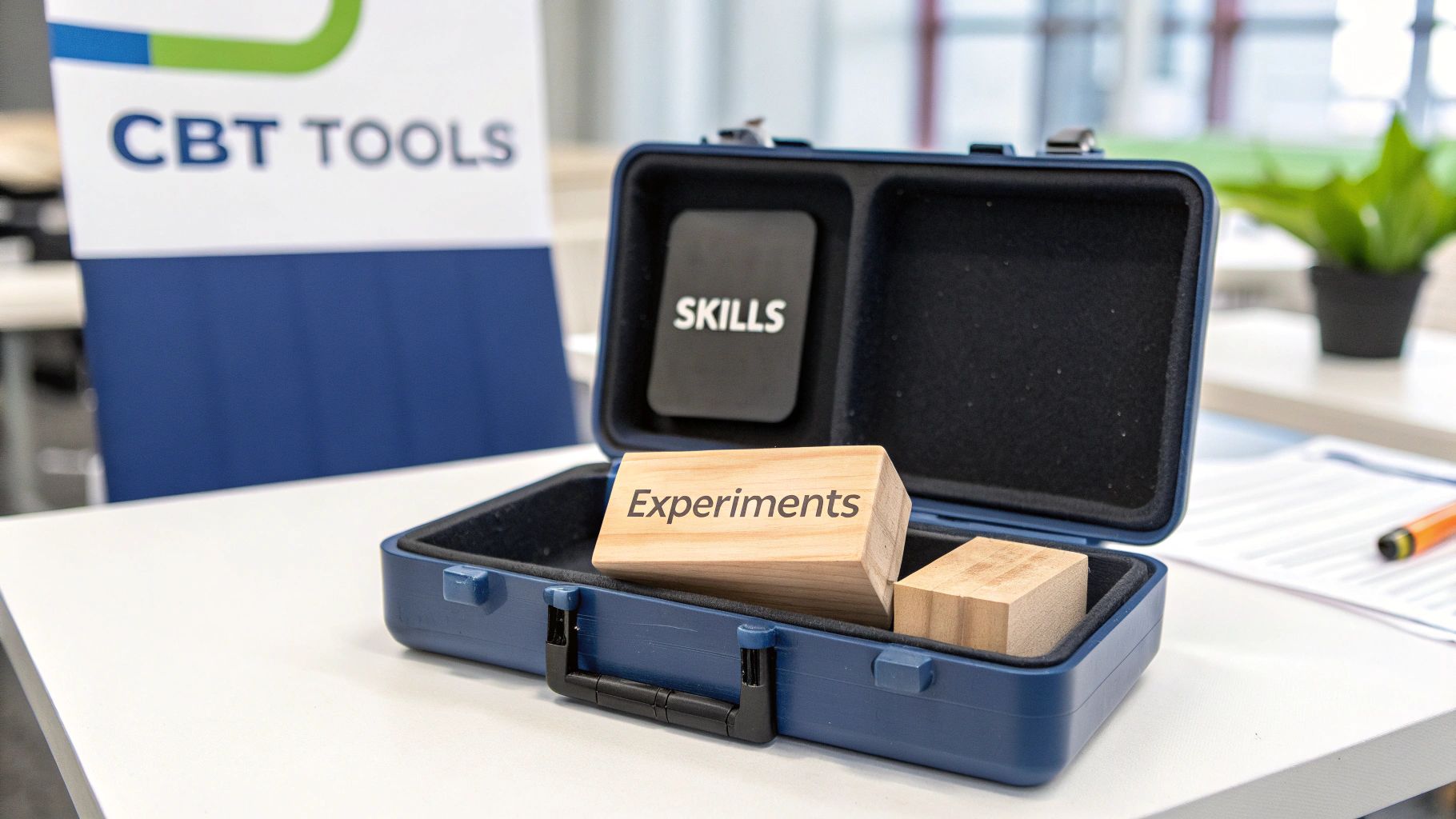
Cognitive Behavioral Therapy isn't just a theory; it's a hands-on approach packed with practical, real-world tools designed to help you regain control. Think of it as a therapist opening their toolbox with you, showing you exactly how you'll build a solid foundation for lasting sobriety. These techniques are the heart of CBT for addiction, and each one helps you tackle a different part of the addictive cycle.
By learning these skills, you shift from simply reacting to triggers and cravings to proactively managing your life. The goal is to give you a set of strategies you can count on long after you've completed a program, building the confidence to navigate challenges without turning back to substances.
Cognitive Restructuring: Catching and Changing Your Thoughts
The first major tool you'll get familiar with is cognitive restructuring. This is all about learning to spot, question, and ultimately change the automatic negative thoughts that so often fuel substance use. These thoughts can feel incredibly real in the moment, pushing you toward self-sabotaging behavior before you even realize it.
For instance, a thought like, "I’ve had a terrible day; I deserve a drink to unwind," might pop into your head. Cognitive restructuring teaches you to hit pause and really look at that thought. You learn to ask yourself, "Is this thought helping me? Is a drink truly the only way I can relax? What happened last time I went down this road?"
This process helps you see these thoughts for what they are: just thoughts, not undeniable facts. With practice, you start replacing them with more balanced and helpful alternatives, like, "This was a tough day, and I'm going to use those breathing exercises I learned to manage this stress."
Behavioral Experiments: Putting Your Beliefs to the Test
Once you start catching those unhelpful thoughts, the next step is often to test them in the real world through behavioral experiments. This is a safe, structured way to challenge the assumptions that keep you feeling stuck. Many people hold deep-seated beliefs about their addiction, such as "I can't possibly go to a party without drinking" or "If I don't use, my anxiety will be completely unbearable."
A behavioral experiment treats that belief like a hypothesis in a science experiment. You'll work with your therapist to design a small, manageable test to see if it’s actually true.
- The Prediction: "If I go to my friend's barbecue and only drink soda, I'll have a miserable time and have to leave after 20 minutes."
- The Experiment: Go to the barbecue with a plan. You'll stay for one hour, stick to non-alcoholic drinks, and focus on having a real conversation with at least one person.
- The Outcome: You might find that while you felt awkward for the first few minutes, you ended up having a great chat and stayed for the entire hour.
This kind of direct experience is incredibly powerful. It gives you concrete proof that your fears are often far worse than the reality, which dramatically weakens the hold those old beliefs have on you.
Skills Training: Building Your Coping Toolbox
Finally, CBT for addiction is heavily focused on skills training. This is where the rubber meets the road. You’ll learn and rehearse new behaviors to handle high-risk situations effectively, building a toolbox of healthy coping mechanisms so you're never left empty-handed when a trigger or craving shows up.
For many of our residents in Massachusetts, social events can feel like a major hurdle in recovery. Skills training provides specific, practical strategies to navigate these moments with confidence.
The core of skills training is about expanding your options. Instead of having only one response to stress—using a substance—you develop a whole range of healthier, more effective alternatives.
Common skills you'll build in CBT include:
- Craving Management: Learning techniques like "urge surfing," where you ride out a craving without acting on it, understanding that it's like a wave that will eventually crest and fade.
- Communication Skills: Getting comfortable saying "no" assertively but politely when offered a substance and learning how to clearly state your needs to friends and family.
- Stress Reduction: Practicing mindfulness, progressive muscle relaxation, or other proven techniques to manage difficult emotions without reaching for something to numb them.
By mastering these skills—restructuring your thoughts, testing your beliefs, and building new coping mechanisms—you’re doing more than just stopping substance use. You're fundamentally changing your relationship with your own mind and building the resilience needed for a strong, sustainable recovery.
Why CBT Is a Trusted Approach for Addiction Treatment
When you're ready to get help for addiction, you want to know the path you're choosing is one you can count on. Cognitive Behavioral Therapy isn't some new-age trend or a hopeful theory; it's one of the most thoroughly researched and proven forms of therapy for substance use disorders. It has stood the test of time for a simple reason: it works.
The trust in CBT comes from its ability to create real, measurable change. It goes beyond just talking through problems and gets right to the heart of building practical skills. This focus on action leads directly to higher rates of sobriety, fewer relapses, and a genuine improvement in mental health. Choosing a treatment backed by this much solid evidence isn't just a good choice—it's a smart, informed step toward a stable recovery.
Grounded in Science, Not Guesswork
The power of CBT for addiction isn't built on stories or wishful thinking; it’s backed by a mountain of clinical research. Countless studies have put it to the test, comparing it against other therapies or no treatment at all, and the results consistently show its value. This scientific foundation gives you the confidence that the time and effort you put in are aimed at a method proven to make a difference.
What this means for you is that your therapist isn't just winging it. They are using a structured, goal-oriented framework that’s been fine-tuned over decades to tackle the specific challenges of addiction. For many people feeling lost in their struggle, just knowing they’re in a program with such a strong track record can bring an incredible sense of hope and motivation.
Why Specialists Rely on CBT
So, what makes CBT a cornerstone of modern addiction treatment? It comes down to a few core strengths that set it apart.
- Proven Effectiveness: Years of clinical trials show that people in CBT have significantly better outcomes than those who get little or no treatment. It’s not a maybe; it’s a proven advantage.
- A Focus on Practical Skills: This isn't just about understanding your past. CBT gives you real-world tools to manage cravings, navigate triggers, and handle stress—skills that last a lifetime.
- Tackles the Whole Picture: Addiction rarely travels alone. CBT is also incredibly effective for treating co-occurring conditions like anxiety and depression, which are often tangled up with substance use.
- Puts You in the Driver's Seat: Therapy is a partnership. CBT is a collaborative process that makes you an active participant in your own recovery, helping you build confidence and self-reliance along the way.
The Evidence Speaks for Itself
The numbers behind CBT’s success are hard to ignore. For example, a massive review covering 53 different randomized clinical trials found that CBT consistently improved results for people dealing with alcohol and other drug addictions. The research showed that this therapy performs 15% to 26% better than no treatment at all.
That kind of data is what turns the hope of recovery into a tangible reality.
A significant review of 53 randomized clinical trials concluded that CBT improves outcomes about 15% to 26% better than no treatment or minimal intervention controls for alcohol and other drug use disorders.
You can explore the full research on its moderate but meaningful effect size to dig deeper. This shows that choosing CBT isn't a leap of faith; it's a decision grounded in verifiable success.
What to Expect from a CBT Program for Addiction
Taking the first step into therapy can feel like jumping into the unknown. But when it comes to Cognitive Behavioral Therapy for addiction, the process is structured, supportive, and designed to put you in the driver's seat. It's not a mysterious process; it's a practical partnership between you and your therapist, focused on building the skills you need for a new way of living.
Think of it as having a clear roadmap for recovery, guiding you from where you are now to where you truly want to be.
https://www.youtube.com/embed/Ig-npH91bIw
To give you a better sense of the journey, here’s a look at what the experience typically involves from start to finish.
Your First Steps: The Assessment and Goal Setting
Your journey starts with a confidential assessment. This isn’t an interrogation—it’s a conversation. A clinician will take the time to get to know you, understand your history with substance use, and learn about your personal strengths and challenges. This initial meeting is absolutely crucial for creating a treatment plan that’s built just for you.
Right after the assessment, you’ll work directly with your therapist to set clear, achievable goals for your recovery. These aren't just generic objectives; they are deeply personal and tied to what you want to achieve. Whether your goal is to mend relationships, get back to work, or simply feel healthier and more present in your life, this collaborative process makes you an active partner in your own healing from day one.
The Structure of Weekly Sessions
Once your plan is set, you'll begin your regular sessions. In a CBT for addiction program, these meetings are focused and goal-oriented. Each session usually starts with a check-in to see how your week went, discussing both the wins and the hurdles you faced. From there, you'll dive into learning and practicing specific CBT skills.
For example, a session might focus on a technique called functional analysis, where you break down a recent craving to pinpoint its exact triggers, the thoughts that came up, and the feelings it produced. The whole point is to make the addiction cycle less overwhelming and much more manageable. Many people in Massachusetts find this structured approach particularly helpful, especially when part of a more intensive schedule like a day treatment program.
Applying Skills with CBT Homework
One of the cornerstones of CBT is taking what you learn and applying it to your daily life. This is often done through "homework"—practical exercises designed to strengthen the skills you're building in therapy. This could mean keeping a thought journal to catch negative thinking patterns in the act or practicing a relaxation technique the moment you feel stress creeping in.
This work outside of therapy is where the real transformation happens. It builds your confidence and proves you can handle difficult situations on your own, turning classroom theory into real-world skill. The results are powerful; one study of a digital CBT program for Alcohol Use Disorder found an abstinence rate of 73.3% in the CBT group, compared to just 30.8% in the control groups. You can read the full research about these CBT findings to see the data for yourself.
CBT isn't just about what happens in the therapy room; it's about equipping you with the tools to manage your life effectively outside of it. The skills you learn become your personal toolkit for long-term recovery.
Integrating CBT with Other Treatments
CBT is a powerhouse on its own, but it becomes even more effective when it works alongside other treatment methods. This integrated approach ensures every part of your well-being—biological, psychological, and social—gets the attention it deserves. A comprehensive plan gives you the best possible chance at lasting recovery.
The table below breaks down how CBT complements other key addiction treatments, creating a holistic and robust support system.
How CBT Integrates with Other Addiction Treatments
This table shows how CBT works alongside other common treatment modalities to create a comprehensive and effective recovery plan.
| Treatment Modality | Primary Function | How CBT Complements It |
|---|---|---|
| Medication-Assisted Treatment (MAT) | Uses medications to reduce cravings and withdrawal symptoms, stabilizing the body's chemistry. | CBT addresses the behavioral side, helping you develop coping skills to manage triggers while the medication supports your physical recovery. |
| Dialectical Behavior Therapy (DBT) | Focuses on managing intense emotions and improving interpersonal relationships through mindfulness. | CBT adds a structured focus on challenging the specific thought patterns that fuel addictive behaviors, working hand-in-hand with DBT's emotional regulation skills. |
| 12-Step Programs (AA/NA) | Provide a framework of peer support, accountability, and spiritual principles for long-term sobriety. | CBT offers the evidence-based psychological tools to put the principles of 12-Step programs into daily practice, strengthening your resolve. |
By weaving these approaches together, we create a safety net that supports you from every angle, making your recovery journey stronger and more sustainable.
Using CBT Skills for Relapse Prevention
Getting sober is one thing; staying sober is another journey altogether. This is where Cognitive Behavioral Therapy really comes into its own. It's not just about stopping substance use—it’s about giving you a practical toolkit to build a resilient, long-term recovery. The whole focus shifts from just getting through today to empowering you to handle whatever life throws your way tomorrow, long before a trigger even shows up.
Four Pillars of Relapse Prevention in CBT
CBT provides a clear, structured roadmap for staying on track. Think of it as building a strong foundation for your recovery, one skill at a time. Here are the four key strategies you'll master.
-
Identify High-Risk Triggers: First things first, you have to become a detective in your own life. We’ll work with you to pinpoint the specific people, places, feelings, or situations that kickstart cravings. This isn't about avoiding life; it's about knowing your personal landscape so you can navigate it safely.
-
Develop Proactive Coping Plans: Once you know what your triggers are, you can create a personalized game plan. If work stress is a big one, your plan might include specific breathing exercises or a quick walk. For social events, it could be as simple as rehearsing how to say "no thanks" before you even leave the house.
-
Reframe the Abstinence Violation Effect: A slip doesn't have to become a slide. A core part of CBT is dismantling the "all-or-nothing" thinking that can turn one mistake into a full-blown relapse. We help you reframe it as a learning moment, not a personal failure.
-
Build Lasting Resilience Skills: Ultimately, the goal is to build up a whole new set of automatic responses. Skills like stress management, emotional regulation, and clear communication become second nature, making healthy choices feel more natural over time.
Identifying Your Personal High-Risk Triggers
A relapse rarely comes out of the blue. It’s almost always the end of a chain reaction that started with a trigger. In CBT, we use a technique called functional analysis to help you map out these patterns.
It sounds complicated, but it's really about looking closely at recent cravings or past relapses and asking some straightforward questions:
- Where were you?
- Who were you with?
- What was going through your mind right before the urge hit?
- What feeling were you trying to chase, or what were you trying to escape?
For someone living on the South Shore, a trigger could be something as specific as driving past a familiar bar on Route 3A or feeling the mounting stress of a commute into Boston. By getting this specific, you strip these cues of their power and can start building effective, real-world strategies. You can dive deeper into addressing cravings and triggers with CBT in our detailed guide.
Overcoming the Abstinence Violation Effect
One of the sneakiest psychological traps in recovery is what's known as the abstinence violation effect. It’s that tidal wave of guilt and shame after a lapse that fuels thoughts like, "Well, I've already blown it. Might as well keep going."
CBT tackles this destructive mindset head-on. It teaches you to separate a single action—using—from your entire identity as a person in recovery.
Instead of seeing a lapse as proof that you've failed, CBT helps you reframe it as data. It’s simply information you can use to figure out what went wrong, tweak your coping plan, and come back even stronger and better prepared.
This shift in perspective is absolutely crucial for staying the course. It turns what feels like a moment of weakness into a building block for future strength. The unfortunate reality is that relapse rates are high across the board; some studies show roughly 75% of people relapse within three to six months of treatment. CBT works to lower that risk by strengthening the psychological pillars of recovery, like self-esteem and anxiety management.
Finding CBT for Addiction Right Here in Massachusetts
Taking that first step to get help is a huge deal, and finding the right local care shouldn't feel like another mountain to climb. If you're in Massachusetts, you have access to excellent CBT for addiction, and here at South Shore Recovery Center, we make getting started as simple as possible. We're with you from that first phone call all the way to finding a program that actually works with your life.
What Level of Care Is Right for You?
One of the best things about CBT is how well it works in an outpatient setting, meaning you can get top-tier treatment while still living at home. The right program intensity really depends on where you are in your recovery journey, and we can help you figure that out.
-
Partial Hospitalization Program (PHP): Think of this as our most structured outpatient option. You'll spend several hours a day with us, five days a week, getting the kind of intensive support you'd find in a residential setting but with the freedom to go home at night.
-
Intensive Outpatient Program (IOP): This program is a step down in terms of time commitment, usually meeting for a few hours a day, three to five days a week. It’s a perfect fit if you're balancing recovery with work, school, or family responsibilities but still need consistent, solid support.
In both our PHP and IOP, CBT isn't just an add-on; it's a central part of the curriculum, focused on teaching you the real-world skills you need to build a lasting recovery.
Making the First Call and Getting Started
Reaching out is straightforward and always confidential. It all starts with a simple phone call. One of our admissions coordinators will listen to your story, answer your questions, and just get to know you. From there, we’ll schedule a clinical assessment so we can get a full picture of what you're going through.
I know that first call can feel like the hardest part. But on the other end of the line, you’ll find nothing but understanding and support. Our entire focus is on making this process feel as safe and easy as it can be.
This assessment is what allows us to build a truly personal treatment plan. We'll use CBT and other proven therapies to tackle not just the substance use, but also any other mental health challenges, like anxiety or depression, that might be part of your story.
Let's Talk About Insurance Coverage in Massachusetts
Worrying about how to pay for treatment should never get in the way of your health. We partner with most of the major insurance carriers in Massachusetts, including plans like MassHealth and Blue Cross Blue Shield, to keep care affordable.
Our team knows the ins and outs of insurance. We'll handle verifying your benefits for you, breaking down exactly what's covered, and explaining any out-of-pocket costs upfront. We want you to walk in with no financial surprises, so you can put all your energy into what really matters: your recovery.
Frequently Asked Questions About CBT for Addiction
As we wrap up, it's natural to have a few lingering questions. Let's tackle some of the most common ones we hear about using CBT for addiction to help you feel confident and clear about what this therapy involves.
How long does CBT for addiction typically last?
There's no one-size-fits-all timeline, but CBT is designed to be time-limited. For many people in outpatient programs, like the ones we offer here in Massachusetts, a course of treatment might last anywhere from several weeks to a few months. The focus is always on getting you the skills you need to manage on your own, not keeping you in therapy forever.
Is CBT effective for all types of addiction?
Yes, it's highly adaptable. CBT has been successfully used to treat a whole host of substance use disorders, including addiction to alcohol, opioids, stimulants, and cannabis. It also works well for behavioral addictions like gambling.
How long does it take to see results with CBT?
Everyone’s journey is different, but many people start noticing positive changes within just a few weeks. Because CBT is so structured and goal-focused, you can often see progress pretty quickly, even though long-term recovery is an ongoing process.
Can CBT work if I’ve relapsed before?
Absolutely. In fact, this is one of CBT's greatest strengths. It’s fantastic for relapse prevention because it helps you pinpoint the exact thoughts and situations that led to past relapses and gives you new, much more effective strategies for handling them next time.
Is CBT a good fit for everyone?
CBT works best for people who are ready to roll up their sleeves and get actively involved in their own recovery. If you’re motivated to learn practical coping strategies and are willing to put them into practice through things like journaling or trying new behaviors, you’ll likely find it incredibly rewarding. It’s a very hands-on, skills-based approach.
