

When a person struggles with a mental health condition and a substance use disorder simultaneously, a specialized approach is required for effective healing. This guide offers a comprehensive look at dual diagnosis treatment, an integrated care model that addresses both conditions at once to break the cycle of self-medication and worsening symptoms. For those in Plymouth and across Massachusetts, understanding this approach is the first step toward finding lasting recovery.
Key Takeaways
- What it is: A dual diagnosis is when you have a mental health disorder and a substance use disorder at the same time.
- Why it's tricky: The two conditions tend to make each other worse, creating a cycle that's hard to break without the right kind of help.
- The best approach: The gold standard is integrated treatment, where both conditions are treated together in a coordinated way, not as separate problems.
- Help is close by: Expert programs designed for these complex needs are available right here in Massachusetts, including in the Plymouth area.
When someone is grappling with both a mental health condition and a substance use disorder at the same time, they need a special kind of help. This is where dual diagnosis treatment comes in. It’s an integrated approach, and it's essential because these two issues are often deeply intertwined, feeding into each other and creating a vicious cycle that’s tough to escape. Trying to treat them separately just doesn't work; you have to tackle both head-on, together, to build a strong foundation for recovery.
What Is a Dual Diagnosis?
A dual diagnosis, sometimes called a co-occurring disorder, simply means that a person is dealing with a mental health issue—like depression, anxiety, or PTSD—and a substance use disorder simultaneously.
Think of it like trying to bail out a boat with two holes in it. If you only patch one hole, the boat is still going to sink. The same logic applies here. Mental health and addiction are linked, and the only way to stay afloat is to address both at once. If you don't, the untreated condition almost always ends up torpedoing any progress made on the other, which is why the risk of relapse is so much higher.
This isn't a rare situation, either. The connection is incredibly common. Data from the Substance Abuse and Mental Health Services Administration (SAMHSA) reveals that nearly half of all people with a mental illness will also struggle with a substance use disorder at some point in their lives. To put that in perspective, in 2022 alone, about 23.1% of U.S. adults—that's nearly 60 million people—had some form of mental illness. You can discover more about the latest addiction and mental health trends from Evolve Indy.

Why Integrated Care Is a Necessity
Imagine trying to treat a substance use problem without ever talking about the underlying anxiety that fuels it. Or trying to manage deep depression while ignoring a dependence on alcohol. It's a recipe for failure because one condition constantly triggers the other.
A specialized dual diagnosis treatment plan isn't just a "nice-to-have"—it's a must. It means the clinical team gets the whole picture, understanding how mental health symptoms and substance use interact. This allows them to create a single, supportive path forward.
Why Integrated Treatment Is the Gold Standard
Think about trying to put out two fires burning right next to each other. If you only focus on one, the heat from the second fire will just reignite the first. It's a losing battle. This is a perfect way to understand the problem with treating mental health and substance use separately—it’s an outdated approach that just doesn't work when someone has a dual diagnosis.
When these two conditions exist together, they're not just neighbors; they're deeply tangled, feeding off each other in a vicious cycle. Trying to treat only one side of the problem almost guarantees the other will pull the person back into the struggle.

That's why modern dual diagnosis treatment champions integrated care. Instead of shuffling a person between a mental health clinic and a separate addiction center, this model brings all the experts under one roof. A single, unified team collaborates on one comprehensive treatment plan, addressing both conditions simultaneously.
The Problem with Separated Care
In the past, the healthcare system often operated in silos. It wasn't uncommon for someone to be told their anxiety was "too severe" for an addiction program, or that they had to get sober before a psychiatrist would even consider treating their depression. This created dangerous gaps in care that left people feeling hopeless and stuck.
For instance, think of someone in Massachusetts who struggles with social anxiety and uses alcohol to cope in social situations. If they only go to rehab for their drinking, the root cause—the anxiety—is never addressed. It’s only a matter of time before that untreated anxiety flares up, and they return to the only coping mechanism they know.
On the flip side, someone managing bipolar disorder might find that substance use throws their moods into chaos, making their medication ineffective and triggering severe manic or depressive episodes. If they only see a psychiatrist for their bipolar disorder, the substance use remains a constant threat to their stability.
Key Takeaways of Integrated Care
- Treats the Whole Person: It moves beyond isolated symptoms to look at the complete picture of a person's health.
- One Cohesive Team: A single clinical team works together, sharing insights to craft a single, holistic treatment plan.
- Simultaneous Treatment: The mental health disorder and the substance use disorder are addressed in tandem, at the same time.
- Better, Lasting Outcomes: This approach is proven to deliver stronger results and significantly lower the risk of relapse.
How Integrated Treatment Creates Lasting Change
The real power of integrated dual diagnosis treatment is its ability to help people untangle the complicated knot of their co-occurring conditions. A therapist can help a person see precisely how their depression fuels their desire to use, and how their substance use worsens their depression. These "aha" moments are crucial for recovery, allowing someone to finally understand the full dynamic and begin building healthier ways to cope.
By addressing both conditions simultaneously, integrated treatment equips individuals with the skills to manage mental health symptoms without relying on substances, and to maintain sobriety by strengthening their emotional resilience.
This approach understands that one condition isn't more "important" than the other. They are two sides of the same coin. A quality treatment program near Plymouth will have clinicians specifically trained to manage this complex interplay, ensuring every aspect of the recovery plan—from therapy sessions to medication management—supports both sides of the healing process.
The evidence is clear and overwhelming. Study after study shows that people in integrated programs have better outcomes, including reduced substance use and improved mental health, and are far more likely to stick with their treatment than those in separate programs. You can learn more about trends in U.S. mental health and addiction treatment to see how the industry is embracing this superior model.
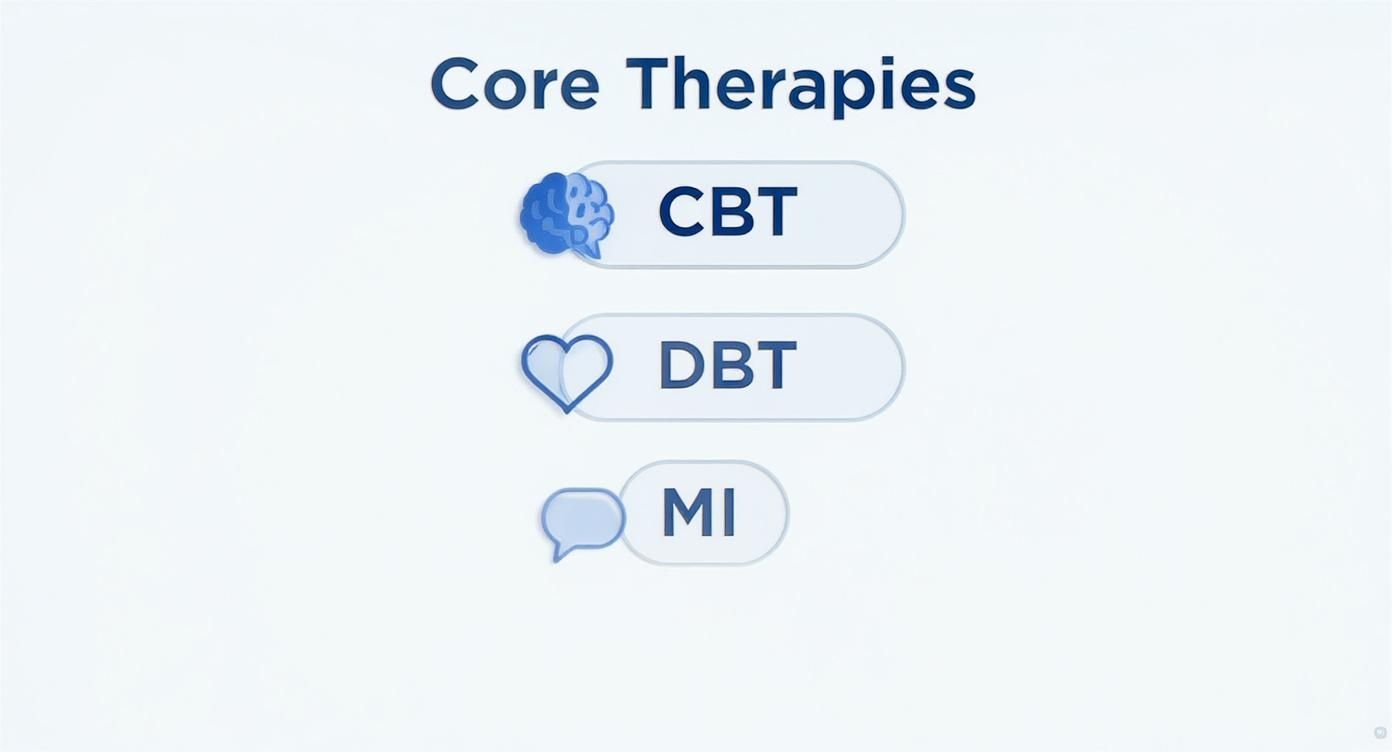
Core Therapies Used in Dual Diagnosis Programs
When you start a dual diagnosis treatment program, it can feel a bit overwhelming, with new routines and terminology. But at the core of it all are a handful of proven, evidence-based therapies. These aren't just abstract theories; they are practical, hands-on approaches designed to give you real tools for lasting recovery.
The main goal is to untangle the complicated knot between your thoughts, feelings, and actions. Once you see how one influences the other, you can start breaking those destructive cycles and building healthier habits. Think of it like a therapist giving you a specific set of tools—a wrench to tighten up loose emotional regulation, or a new blueprint to rewire negative thinking—so you can actively rebuild your well-being from the ground up.

Cognitive Behavioral Therapy (CBT)
Cognitive Behavioral Therapy, or CBT, is a true cornerstone of modern dual diagnosis treatment. It’s based on a straightforward but incredibly powerful idea: it's not the events in our lives that upset us, but the thoughts we have about them. CBT essentially helps you become a detective of your own mind.
You learn to spot and challenge the automatic negative thoughts that can trigger both substance cravings and mental health symptoms. For instance, someone with social anxiety might think, "If I go to this party, I'll just say something stupid and everyone will think I'm an idiot." That thought creates anxiety, which they might then try to numb with a drink.
CBT teaches you to catch that thought, examine it, and reframe it into something more balanced: "I might feel nervous, and that's okay. I can have one or two short conversations and leave if I start feeling overwhelmed." By changing the thought, you short-circuit the entire emotional and behavioral chain reaction. You can dive deeper into how to use CBT to address substance use disorder cravings and triggers in our detailed guide.
Dialectical Behavior Therapy (DBT)
While CBT is great for changing thought patterns, Dialectical Behavior Therapy (DBT) is all about equipping you with skills to manage intense emotions and build healthier relationships. It was first created to help people with borderline personality disorder, but its practical tools are incredibly helpful for anyone who struggles with emotional dysregulation—a common thread in dual diagnosis.
DBT is organized around four key skill sets that give you a powerful toolkit for navigating life:
- Mindfulness: Learning to stay grounded in the present moment without judging yourself or the situation.
- Distress Tolerance: Getting through a crisis without making it worse. These are the skills you use when you can't fix a problem right away.
- Emotion Regulation: Understanding your emotions, reducing your vulnerability to negative ones, and learning how to change them.
- Interpersonal Effectiveness: Communicating your needs and setting boundaries in a way that maintains your self-respect and keeps your relationships healthy.
For someone whose anger or despair often leads them back to using, DBT offers concrete strategies—like specific breathing exercises or self-soothing techniques—to help them ride the wave of that emotion instead of getting pulled under by it.
Motivational Interviewing (MI)
Let’s be honest: change is hard. Often, the biggest hurdle is our own mixed feelings about it. That's where Motivational Interviewing (MI) comes in. It's not about a therapist telling you what to do; it’s a collaborative, guided conversation designed to help you find and strengthen your own motivation to change.
The core idea behind Motivational Interviewing is that the drive to change has to come from within. A therapist acts as a partner, helping you explore your own reasons for wanting a better life. This empowers you to take ownership of your recovery.
Instead of lecturing, a therapist might say something like, "So on one hand, alcohol helps you unwind after a long week. But on the other, you mentioned it's been causing arguments with your family. Tell me more about that." This non-judgmental approach lowers defensiveness and helps you build the internal resolve needed to commit to your dual diagnosis treatment. It’s a foundational technique used in top programs across Massachusetts to make sure you aren't just going through the motions, but are truly invested in your own success.
Finding Your Place on the Care Continuum
Recovery isn't a straight line with a single starting point. It's more like a journey, and the path is different for everyone. That’s why dual diagnosis treatment is structured as a continuum of care, with different levels designed to meet you exactly where you are.
Think of it this way: a doctor wouldn't treat a sprained ankle the same way they'd treat a major surgery. It's the same in recovery. For those of us here in Plymouth and across Massachusetts, figuring out which level of support you need is the first, most important step toward getting well. The goal is to find that "just right" amount of structure and therapy, setting you up for lasting success.
Full-Time Care: Residential and Inpatient Treatment
At the most intensive end of the spectrum, you have residential or inpatient programs. This is where you live at the facility, in a completely structured and supervised environment, 24/7.
This level of care is really for people who need to hit the pause button on their daily lives. It offers a safe space away from triggers and stressors, allowing you to focus entirely on healing. With round-the-clock support and intensive therapy, you build a strong foundation alongside others who understand what you're going through. Stays typically last anywhere from 30 to 90 days, depending on your specific needs.
A Structured Alternative: Partial Hospitalization Programs (PHP)
One step down from residential care is the Partial Hospitalization Program, or PHP. You’ll also hear it called a Day Treatment Program (DTP). This is a powerful, highly structured option that doesn't require you to live at the treatment center.
You'll attend therapy for several hours each day, usually five to seven days a week, and then head back to your own stable home environment at night. It’s an ideal middle ground.
A Partial Hospitalization Program offers the intensity of an inpatient program but with the real-world flexibility of living at home. It’s perfect for someone who needs significant daily support but doesn't require 24/7 medical supervision.
PHP is a great fit for people transitioning out of a residential program or for those who need more than what traditional outpatient therapy can offer. It’s a robust form of dual diagnosis treatment that helps you build skills while you start putting them to use in your daily life.
Flexible Support: Intensive Outpatient and Outpatient Programs (IOP & OP)
As you build momentum in your recovery, you might move into an Intensive Outpatient Program (IOP) or a standard Outpatient Program (OP). These levels offer much more flexibility, which is crucial when you're juggling recovery with work, school, or family life.
- Intensive Outpatient Program (IOP): This typically means coming in for therapy a few hours a day, a few times a week. It provides that consistent, professional support you need while giving you plenty of time to practice your new coping skills in real-world situations.
- Outpatient Program (OP): As the least intensive option, OP usually involves just one or two therapy sessions per week. It’s fantastic for long-term maintenance, helping you stay on track after you’ve completed a more intensive program.
Getting a clear picture of the different levels of treatment at South Shore Recovery Center and why it matters is the best way to figure out which step makes the most sense for you right now.
To make it even clearer, here's a quick breakdown of how these levels of care compare.
Comparing Dual Diagnosis Treatment Levels of Care
This table helps illustrate the key differences between the programs, making it easier to see where you or a loved one might fit best.
| Level of Care | Primary Setting | Time Commitment | Best Suited For |
|---|---|---|---|
| Residential/Inpatient | Live-in facility | 24/7, for 30-90+ days | Individuals needing medical stabilization and a highly structured, trigger-free environment. |
| Partial Hospitalization (PHP/DTP) | Treatment center | 5-7 days/week, several hours/day | Those who need intensive daily therapy but have a stable home life and don't require 24/7 supervision. |
| Intensive Outpatient (IOP) | Treatment center | 3-5 days/week, a few hours/day | People balancing recovery with work or family who need consistent, structured support. |
| Outpatient (OP) | Treatment center or therapist's office | 1-2 sessions/week | Individuals seeking long-term maintenance and ongoing support after completing a higher level of care. |
Each level has a distinct purpose, but they all work together to create a complete safety net. The right plan is one that can adapt as your needs change, ensuring you always have the right support at the right time.
What to Expect for Patients and Families on the Journey to Recovery
Taking the first step into a dual diagnosis treatment program is a huge moment of hope, not just for the person struggling, but for their entire family. It’s a path with clear stages, each one designed to help build new skills, heal old wounds, and lay down a solid foundation for a life in recovery. Knowing what’s ahead can help calm any nerves and make everyone feel more prepared.
The Patient's Experience in Treatment
The journey starts with a comprehensive intake and assessment. Think of this as an open, confidential conversation—not a test. Our clinical team sits down with you to understand your story: your history with substance use, the mental health symptoms you're experiencing, and what you hope to achieve. It’s a collaborative effort to design a care plan that truly fits you.
From there, you move into the active therapy phase. This is where the real work begins. You'll participate in both one-on-one and group sessions, learning practical, evidence-based skills to navigate life’s challenges. The goal is to build your resilience, recognize your triggers, and find healthier ways to manage both cravings and mental health symptoms.
Before you complete the program, we focus on aftercare planning. This is an absolutely critical step. Together, we’ll create a detailed roadmap for what comes next, ensuring you have the support you need to thrive long-term. This plan will outline things like ongoing therapy, local support groups, and personal strategies for handling real-world situations.

The Essential Role Families Play in Healing
Addiction and mental health conditions are never a solo experience; they send ripples through the entire family. That's why family involvement isn't just a nice add-on—it's a powerful force for lasting recovery. Loved ones are more than just sideline supporters; they are vital members of the healing team.
Effective treatment programs in Massachusetts make a point to offer dedicated family therapy sessions. These meetings create a safe, professionally guided space to start rebuilding trust, improve how you communicate, and work through some of the unhealthy dynamics that may have taken root. It’s an opportunity for everyone to heal together and learn a new way forward.
Family members learn to shift from enabling behaviors to providing constructive, healthy support. This involves setting firm boundaries, which protect both their well-being and their loved one's recovery journey.
By taking part, families help create a strong, supportive environment that reinforces the new skills being learned in treatment. There’s a fine line between helping and enabling, and learning to walk it is game-changing. To dig deeper into this, you can learn more about moving forward from addiction with family support and see how it strengthens long-term success.
How to Find the Right Treatment Center Near Plymouth
Trying to find the right help for a co-occurring disorder can feel overwhelming, but you're not in this alone. The single most important decision you'll make is choosing a high-quality dual diagnosis treatment center that truly understands what you're going through. This guide will walk you through what to look for and the right questions to ask, so you can find a program in the Plymouth, Massachusetts area that sets you up for a healthier future.

First things first: you need to find a center that specializes in integrated care. Not every facility is built to manage the delicate interplay between mental health and substance use. When you start making calls, don't be shy—ask direct questions to get a real feel for their expertise.
Key Questions to Ask a Treatment Center
Before you commit to a program, you need to be confident in their approach. A good facility will be open and transparent, welcoming your questions instead of dodging them.
Here are the essentials you need to cover:
- "How do you actually integrate mental health and substance use care?" Look for an answer that describes a single, unified team working from one treatment plan. You want to avoid places that treat these as two separate problems.
- "What specific experience does your staff have with my condition?" Get into the details. Ask about their clinicians' credentials and, more importantly, their hands-on experience treating your specific mental health diagnosis alongside addiction.
- "Is your facility licensed and accredited?" This is non-negotiable. In Massachusetts, facilities must be licensed by the Department of Public Health (DPH). National accreditations from groups like CARF or The Joint Commission are also a great sign of a high-quality program.
- "Do you offer the level of care that's been recommended for me?" Make sure they have the right program intensity, whether that's a Day Treatment Program (DTP), a Higher-Level Day Treatment Program (HDTP), or an Intensive Outpatient Program (IOP).
A truly integrated program won't hesitate to explain how their psychiatric and addiction specialists work together every single day. That collaboration is the bedrock of good dual diagnosis treatment.
Verifying Insurance and Navigating Admissions
Dealing with insurance can be a real roadblock for many people, but it doesn't have to be. Any solid treatment center will have dedicated admissions staff ready to help. Their job is to take that burden off your shoulders by contacting your insurance provider, verifying your benefits, and clearly explaining what’s covered and what your out-of-pocket costs might be.
After the insurance piece is figured out, the next step is usually a confidential assessment. Think of it as a conversation—not an interrogation—to make sure the program is the right match for you. This straightforward process is designed to make it easier for you to take that first crucial step. By asking the right questions, you can find a center near Plymouth that offers the expert, compassionate care you deserve.
Frequently Asked Questions About Dual Diagnosis
When you're facing both a mental health challenge and a substance use issue, it’s natural to have a lot of questions. The path to recovery can seem complicated, but getting clear answers is the first step toward finding your footing. We're here to walk you through some of the most common questions we hear from people right here in Massachusetts.
How Do I Know If I Have a Dual Diagnosis?
A dual diagnosis simply means that you're struggling with a mental health condition (like depression, anxiety, or PTSD) and a substance use disorder at the same time. It’s incredibly common, but the only way to be sure is to get a formal diagnosis from a qualified professional, like a psychiatrist or a licensed therapist.
They’ll conduct a comprehensive assessment to understand your symptoms, your history with substance use, and—most importantly—how the two are connected. If you even suspect this might be what you're dealing with, the best thing you can do is schedule an evaluation at a center specializing in integrated care. It's a confidential, judgment-free process designed to point you toward the right support.
Will My Health Insurance Cover Dual Diagnosis Treatment in Massachusetts?
Yes, in most cases. Massachusetts law requires most health insurance plans to cover treatment for both mental health and substance use disorders as essential health benefits.
However, the specifics of what and how much is covered can differ quite a bit between plans. The smartest move is to contact your insurance provider directly. Even better, let the treatment center you're considering check your benefits for you. They have experience with this and can quickly figure out what levels of care (like a Day Treatment Program or an IOP) are covered, what your out-of-pocket costs might be, and handle all the pre-authorization paperwork.
What Is the First Step to Getting Help?
Making that first move can feel like the hardest part, but it's actually pretty straightforward: reach out for a confidential assessment.
You can call a specialized dual diagnosis treatment center directly to set one up. Or, if you prefer, you can talk to your primary care doctor for a referral. This initial evaluation isn't a commitment; it's just a conversation. It’s a chance for a professional to understand your situation and recommend a path forward. Taking that step is a huge act of courage and the beginning of building a healthier life.
Does integrated treatment take longer?
Not usually. Because it's a more efficient and effective model, integrated treatment often helps people achieve stable, long-term recovery more quickly than bouncing between separate, uncoordinated providers. By addressing the root causes simultaneously, it can prevent the cycle of relapse that prolongs the recovery process.
How can I support my loved one without enabling their behavior?
Supporting a loved one means encouraging their recovery efforts, participating in family therapy, and celebrating their progress. Enabling, on the other hand, involves actions that shield them from the consequences of their choices, like making excuses for them or providing financial support for their substance use. Family therapy is the best place to learn how to navigate this difficult but crucial distinction.
